Multi-Platform SEO Across AI Search Engines 2026
If you’re only optimizing for Google in 2026, you’re already losing.
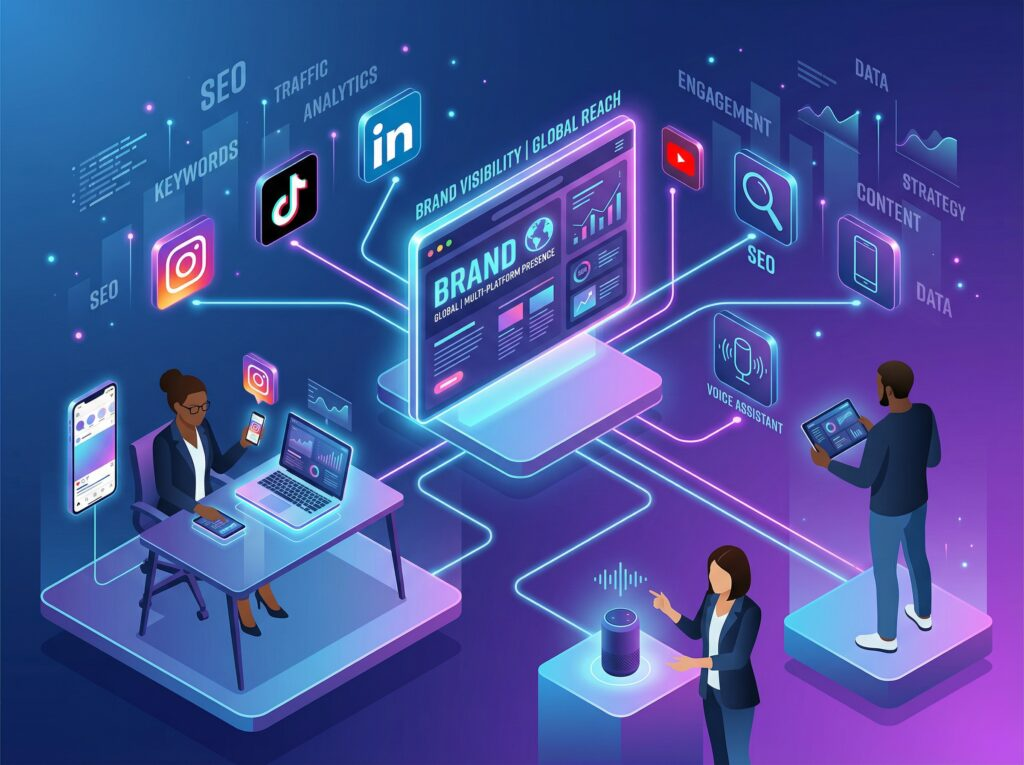
The search landscape has fundamentally transformed. While you’ve been perfecting your keyword density and building backlinks, 40% of your target audience has moved to ChatGPT for product research. Another 25% starts their buyer journey on Reddit or LinkedIn. Traditional Google SEO alone is no longer sufficient for visibility—it’s become just one channel in a diversified content discovery ecosystem.
For growth marketers starting their SEO strategy from scratch, this shift presents both a challenge and an unprecedented opportunity. You’re not burdened by legacy tactics that no longer work. You can build a modern, multi-platform approach from day one that captures traffic wherever your audience searches.
Act 1: The New Search Reality – Why Multi-Platform Presence Is Non-Negotiable
The Fragmentation of Search Behavior
Search behavior has splintered across multiple platforms, each serving different user intents:
AI Conversational Search (ChatGPT, Perplexity, Claude): Users seek comprehensive, synthesized answers to complex questions. When someone asks ChatGPT “What’s the best CRM for a 50-person SaaS startup?”, they expect a nuanced analysis, not ten blue links.
Traditional Search (Google, Bing): Still dominant for navigational queries, local searches, and transactional intent. Google processes 8.5 billion searches daily, but the nature of these searches is changing—more branded, more specific, more transactional.
Social Search (Reddit, LinkedIn, TikTok): Users trust peer recommendations over corporate content. “Reddit CRM recommendations” has become a search modifier because people want authentic user experiences, not marketing copy.
Video Search (YouTube): The world’s second-largest search engine, where users learn through visual demonstration. Tutorial searches, product reviews, and educational content dominate this platform.
The Data Behind Multi-Platform Strategy
Recent studies reveal the urgency:
– 43% of Gen Z and Millennial users start product research on AI chatbots rather than traditional search
– Reddit referral traffic to commercial websites increased 189% year-over-year
– LinkedIn has become the primary B2B discovery platform, with 58% of B2B buyers using it for vendor research
– Voice and AI search queries grew 312% since 2024
When you optimize for only Google, you’re potentially missing 60% of your addressable audience. For growth marketers, this isn’t about adding channels—it’s about survival.
The Competitive Advantage Window
Here’s the opportunity: Most companies are still figuring this out. Their SEO strategies were built for 2019, not 2026. As a growth marketer starting fresh, you can leapfrog competitors by building a truly multi-platform content strategy from the foundation.
The companies winning right now aren’t SEO experts—they’re distribution experts who understand that great content needs to be discovered everywhere, not just ranked on Google.
Act 2: How AI Search Platforms Change Ranking Factors
The Fundamental Shift in Content Evaluation
AI search engines don’t rank content—they synthesize it. This changes everything.
Traditional Google SEO focuses on:
– Keywords and semantic relevance
– Backlink authority
– Domain authority
– Technical SEO signals
– User engagement metrics
AI platforms like ChatGPT and Perplexity evaluate:
– Factual accuracy and citation quality: Is your content trustworthy enough to reference?
– Information density: Do you provide substantive answers or fluffy content?
– Structured data clarity: Can AI easily extract and understand your key points?
– Entity recognition: Are you establishing clear topical authority?
– Freshness and currency: Is your information current and updated?
The New Ranking Factors for AI Visibility
1. Citation Worthiness Over Click Worthiness
AI models train on and reference authoritative sources. To become citation-worthy:
– Publish original research, data, and case studies
– Use proper structured data markup (Schema.org)
– Maintain consistent NAP (Name, Address, Phone) across the web
– Build genuine authority through quality publications and mentions
2. Semantic Depth Over Keyword Optimization
AI understands context and nuance. Instead of keyword stuffing:
– Answer the full spectrum of related questions
– Provide comprehensive topic coverage
– Use natural language that addresses user intent
– Include relevant entities, concepts, and relationships
3. Trust Signals Over Link Quantity
AI evaluates source credibility:
– Author credentials and expertise (E-E-A-T)
– Publication reputation
– Fact-checking and citation practices
– Community validation (social proof, reviews, testimonials)
4. Structured Information Over Long-Form Prose
AI extracts structured data more easily:
– Use clear headings and hierarchies
– Implement tables, lists, and data visualizations
– Add FAQ schema markup
– Create quotable, extractable insights
How AI Search Actually Works
When a user queries ChatGPT or Perplexity:
1. Query Understanding: The AI interprets intent, context, and nuance
2. Knowledge Retrieval: It searches trained data, real-time web results, and proprietary indexes
3. Synthesis: Multiple sources are combined into a coherent answer
4. Citation: Some platforms cite sources (Perplexity, SearchGPT); others synthesize without attribution
Your goal is to be the source that gets retrieved and cited. This requires different optimization than traditional SEO.
The Search Intent Evolution
AI search has introduced new query types:
Comparison queries: “Compare project management tools for remote teams under $1000/month”
– Traditional SEO: Create comparison pages
– AI optimization: Provide detailed comparison tables with specific criteria
Synthesis queries: “What are the emerging trends in B2B content marketing for 2026?”
– Traditional SEO: Trend articles with keywords
– AI optimization: Data-backed insights with specific examples and citations
Procedural queries: “How do I implement SSO for a SaaS application?”
– Traditional SEO: Step-by-step tutorials
– AI optimization: Clear, structured procedures with technical specifications
Understanding these query types helps you create content that AI platforms will reference.
Act 3: Platform-Specific Optimization Tactics for Maximum Visibility
Google: The Foundation Layer
Google remains critical for brand searches, local queries, and transactional intent.
Core tactics:
– Technical excellence: Fast load times, mobile optimization, Core Web Vitals
– Topical authority: Comprehensive content clusters around core topics
– Quality backlinks: Focus on relevance over quantity
– User experience: Clear navigation, helpful content, satisfying search intent
– Local SEO: Google Business Profile optimization for local visibility
Growth marketer approach: Build topic clusters systematically. Start with pillar content on your core value proposition, then create supporting content addressing every related question. Use tools like AnswerThePublic and People Also Ask data.
YouTube: Visual Search Dominance
YouTube is where people learn, compare, and make buying decisions visually.
Core tactics:
– Keyword-optimized titles: Front-load primary keywords naturally
– Comprehensive descriptions: Use the first 200 characters strategically
– Timestamp chapters: Help viewers (and algorithms) understand content structure
– Engagement optimization: Hook viewers in first 30 seconds, encourage comments
– Playlist strategy: Group related content to increase session watch time
– Thumbnail psychology: High contrast, readable text, emotional connection
Growth marketer approach: Create a “content flip” strategy—turn every blog post into a video, every case study into a breakdown. YouTube content often ranks in Google search results, giving you dual visibility.
Reddit: Community-Driven Discovery
Reddit has become a trust layer for search. People add “Reddit” to searches for authentic opinions.
Core tactics:
– Authentic participation: No spam, genuine community contribution
– Helpful expertise: Answer questions in relevant subreddits consistently
– User-generated content mining: Identify pain points and questions for content creation
– Strategic profile optimization: Consistent username, clear expertise area
– Long-form value: Reddit rewards detailed, helpful responses
Growth marketer approach: Spend 30 minutes daily in 3-5 relevant subreddits. Provide genuinely helpful answers. Include resources when relevant (not promotional). Build reputation over months. Reddit traffic is high-intent and converts exceptionally well.
LinkedIn: B2B Search Authority
For B2B growth marketers, LinkedIn is where decision-makers discover solutions.
Core tactics:
– Personal brand optimization: Keyword-rich headline, comprehensive experience
– Consistent publishing: Articles and posts demonstrating expertise
– Engagement strategy: Comment thoughtfully on industry content
– Company page optimization: Complete information, regular updates, showcase pages
– Employee advocacy: Team members sharing and engaging with content
– LinkedIn SEO: Optimize for in-platform and Google search
Growth marketer approach: Post short-form insights 3x weekly, long-form articles 2x monthly. Repurpose your best blog content into LinkedIn articles. Engage authentically with your ICP’s content daily.
ChatGPT & AI Search Platforms: The New Frontier
Optimizing for AI search requires thinking beyond traditional SEO.
Core tactics:
– Citation-worthy content: Original data, research, case studies
– Structured data implementation: Schema markup for all content types
– Entity optimization: Consistently mention relevant entities, products, concepts
– FAQ content: Address common questions explicitly and thoroughly
– Authority building: Get mentioned in authoritative sources that AI models trust
– Freshness: Regular content updates with publication dates
– Clear attribution: Author bios, credentials, expertise signals
Growth marketer approach: Create “AI-friendly” content formats:
– Comparison tables with specific criteria
– Step-by-step guides with clear numbering
– Data summaries with sources cited
– Definition pages for key concepts
– Problem-solution frameworks
Perplexity & SearchGPT: Citation-First Platforms
These platforms explicitly cite sources, creating new visibility opportunities.
Core tactics:
– Current information: These platforms prioritize fresh, updated content
– Clear sourcing: Cite your own sources to establish trustworthiness
– Direct answers: Provide concise, quotable responses to common queries
– Alternative perspectives: Present multiple viewpoints fairly
– Numerical data: Statistics, benchmarks, and concrete figures
Growth marketer approach: Monitor which of your pages get cited using referral tracking. Double down on content formats that get traction. Create more content in those formats around related topics.
The Unified Content Strategy
The most effective approach isn’t platform-specific—it’s content-first with platform-specific distribution:
Step 1: Create cornerstone content
Comprehensive, authoritative content that serves as your foundation. This content should be citation-worthy, data-rich, and thoroughly researched.
Step 2: Adapt for each platform
– Blog post → YouTube video → YouTube description with timestamps
– Key insights → LinkedIn posts → LinkedIn article
– Common objections/questions → Reddit responses
– Data points → Infographics → Pinterest/Instagram
– Processes → Step-by-step guides → AI-optimized tutorials
Step 3: Optimize for discovery mechanisms
– Google: Traditional SEO best practices
– YouTube: Video SEO and engagement optimization
– Reddit: Community value and authentic participation
– LinkedIn: Professional networking and thought leadership
– AI platforms: Structured, citation-worthy content
Step 4: Create feedback loops
Monitor which content performs on each platform. Questions on Reddit become blog topics. LinkedIn discussions become video content. AI citation patterns inform future content strategy.
Measuring Multi-Platform Success
Traditional SEO metrics (rankings, organic traffic) are insufficient for multi-platform strategies.
Essential metrics by platform:
Google: Organic traffic, keyword rankings, conversion rate, branded search volume
YouTube: Views, watch time, subscriber growth, traffic to website
Reddit: Referral traffic, upvotes/engagement, community reputation
LinkedIn: Impressions, engagement rate, profile views, connection requests from ICP
AI platforms: Citation mentions, referral traffic from AI search, brand mention volume
Unified metrics: Total search visibility share, cross-platform content efficiency, cost per acquisition across channels, lifetime value by acquisition source.
Building Your Multi-Platform SEO Roadmap
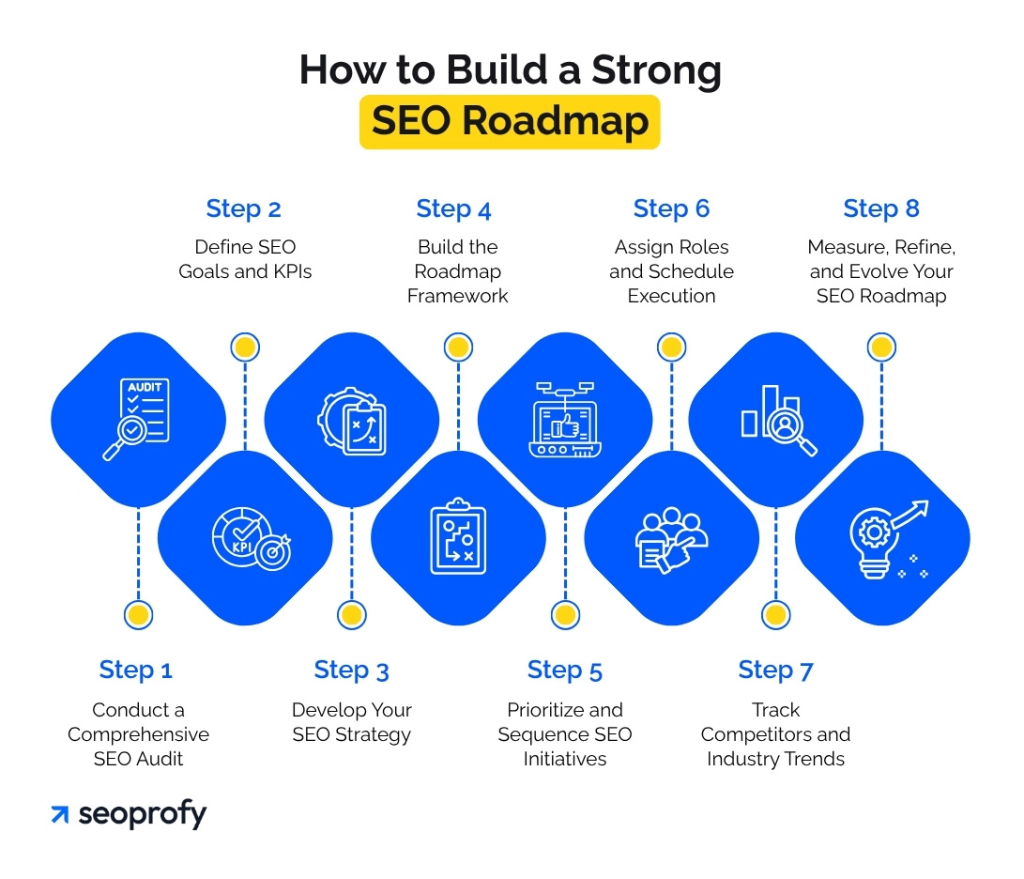
As a growth marketer starting from scratch, prioritize strategically:
Month 1-3: Foundation
– Set up Google Search Console, Analytics, and tracking
– Create 10-15 cornerstone content pieces
– Optimize technical SEO fundamentals
– Establish social profiles on key platforms
– Begin authentic community participation
Month 4-6: Expansion
– Launch YouTube channel with video versions of top content
– Increase Reddit participation to daily engagement
– Publish weekly on LinkedIn
– Implement comprehensive schema markup
– Start original research for citation-worthy content
Month 7-12: Optimization
– Analyze performance across all platforms
– Double down on highest-performing content types
– Develop platform-specific content calendars
– Build strategic partnerships for authoritative mentions
– Refine based on AI citation patterns
The Competitive Moat
Multi-platform SEO creates a compounding advantage. Each platform reinforces the others:
– Google finds your YouTube videos and ranks them
– Reddit discussions link to your blog posts
– LinkedIn articles drive brand searches
– AI citations increase domain authority
– YouTube viewers become blog readers
Your competitors focusing solely on Google are building on a single platform. You’re building an ecosystem.
Conclusion: The Future Belongs to Distribution Masters
The SEO game has evolved from “rank on Google” to “be discovered everywhere your audience searches.” Traditional Google SEO alone is no longer sufficient for visibility—but it’s still an essential component of a broader strategy.
For growth marketers starting fresh, this is your moment. You’re not constrained by legacy tactics or outdated playbooks. You can build a modern, multi-platform content strategy that captures attention wherever your audience looks for answers.
The companies winning in 2026 aren’t doing one thing exceptionally well—they’re doing many things strategically well. They understand that search has fragmented, and visibility requires presence across the entire discovery ecosystem.
Start today. Pick two platforms beyond Google. Create one piece of cornerstone content. Adapt it for each platform. Measure what resonates. Repeat.
The multi-platform SEO game rewards consistent execution over perfection. Your competitors are still debating whether AI search matters. You’re already building for the future of discovery.
If you’re only optimizing for Google in 2026, you’re already losing. But now you know how to win.
Frequently Asked Questions
Q: Should I completely abandon traditional Google SEO?
A: No. Google still processes 8.5 billion searches daily and remains crucial for branded, local, and transactional searches. The key is not abandoning Google SEO, but complementing it with optimization for AI search, social platforms, and video. Think of Google as your foundation, not your entire strategy.
Q: How is AI search optimization different from traditional SEO?
A: AI search platforms synthesize information rather than ranking pages. They prioritize citation-worthy content, factual accuracy, structured data, and information density over backlinks and keyword optimization. Focus on creating comprehensive, well-sourced content that AI can extract and reference, rather than content optimized for click-through rates.
Q: Which platform should I prioritize first as a growth marketer?
A: Start with Google for foundational SEO, then add the platform where your target audience actively searches. For B2B, that’s typically LinkedIn. For B2C products, consider YouTube or Reddit. For service businesses, optimize Google Business Profile. The key is to master one additional platform before expanding further.
Q: How do I measure success across multiple platforms?
A: Track platform-specific metrics (organic traffic for Google, watch time for YouTube, referral traffic from Reddit, engagement rate for LinkedIn) along with unified metrics like total search visibility share, cross-platform content efficiency, and lifetime value by acquisition source. Focus on business outcomes, not vanity metrics.
Q: Do I need to create unique content for each platform?
A: Not entirely. Create comprehensive cornerstone content, then adapt it for each platform’s format and audience expectations. A single piece of research can become a blog post, YouTube video, LinkedIn article, Reddit discussion responses, and AI-optimized FAQ content. This ‘content flipping’ strategy maximizes efficiency while respecting each platform’s unique context.
Q: How long does it take to see results from multi-platform SEO?
A: Expect 3-6 months for initial traction on most platforms. Google SEO typically takes 4-6 months, YouTube 2-4 months with consistent publishing, LinkedIn 1-3 months for engagement growth, and Reddit requires 2-3 months of authentic participation before promotional content is accepted. AI citation visibility can occur more quickly (1-2 months) for truly authoritative, citation-worthy content.