How to Get Free SEO Traffic Without Paid Ads in 2026
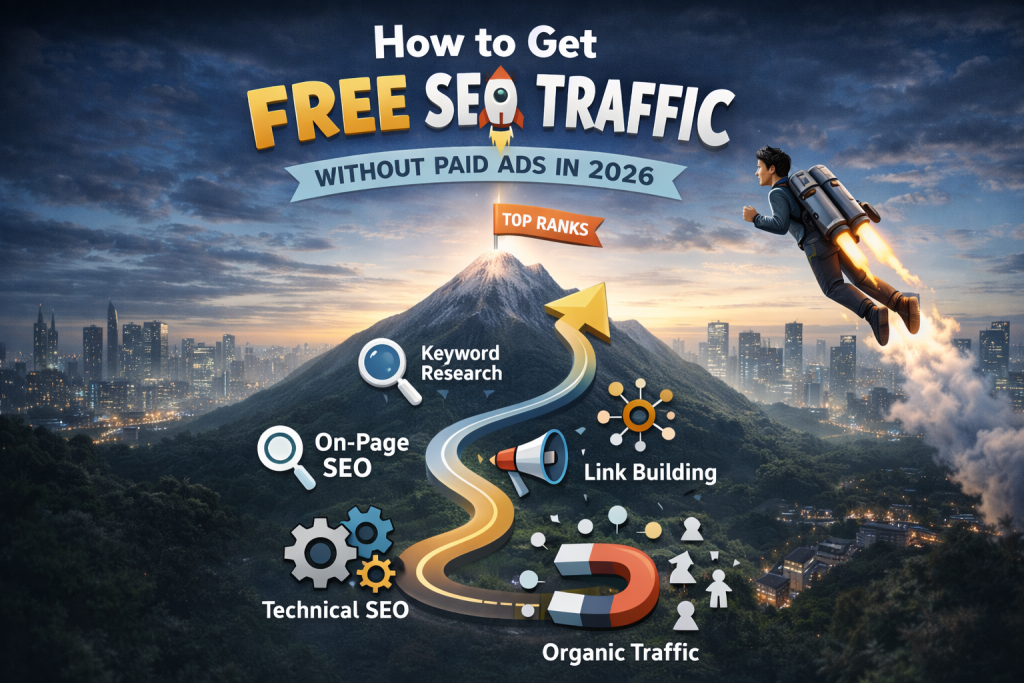
Stop wasting money on ads – this free traffic method is driving real visitors right now.
Every day, small business owners and bloggers drain their bank accounts feeding the paid advertising machine. Google Ads, Facebook Ads, and Instagram promotions, the costs add up quickly, and the moment you stop paying, your traffic disappears. But here’s what the big players don’t want you to know: some of the most successful websites generate massive traffic without spending a single dollar on ads.
The struggle is real. You need consistent visitors to grow your business, but your budget can’t support endless ad campaigns. Meanwhile, SEO feels overwhelming with its technical jargon and constantly changing algorithms. The good news? In 2026, free organic traffic is not only possible, but it’s also more accessible than ever if you know the right strategies.
This guide reveals proven free traffic generation methods that are working right now. No complicated SEO degree required, no massive time investment, and absolutely no advertising budget needed.
Act 1: Step-by-Step Free Traffic Generation Tactics That Require No Budget
Google Business Profile: Your Local SEO Goldmine
If you have any local component to your business, not claiming and optimizing your Google Business Profile is like leaving money on the table. This completely free tool can drive hundreds of targeted visitors to your website every month.
Here’s how to maximize it:
1. Complete every section – Fill out your business description, hours, services, and add high-quality photos. Google rewards complete profiles with better visibility.
2. Choose precise categories – Select your primary category carefully and add relevant secondary categories. This determines when you appear in local searches.
3. Collect reviews consistently – Ask satisfied customers to leave reviews. Even 10-15 positive reviews can dramatically improve your local search rankings.
4. Post weekly updates – Use the Posts feature to share updates, offers, or valuable content. These appear directly in search results and keep your profile active.
Businesses that fully optimize their Google Business Profile see an average 35% increase in website clicks within 3 months, according to 2025 data from local SEO studies.
Content SEO Fundamentals: Creating Traffic Magnets
Content remains king in 2026, but the approach has evolved. You don’t need to publish daily or create 5,000-word articles. You need strategic, targeted content that answers specific questions.
The modern content SEO workflow:
1. Keyword research with free tools – Use Google’s autocomplete, “People Also Ask” boxes, and free tools like Answer The Public to find questions your audience is actually asking. Forget expensive keyword tools; these free sources reveal real search intent.
2. Target search intent, not just keywords – When someone searches “best running shoes,” are they looking to buy, compare brands, or learn about shoe technology? Match your content to their actual intention.
3. Optimize your titles and headers – Include your target keyword in the title (preferably toward the beginning) and use it naturally in H2 and H3 headers. But write for humans first—forced keyword stuffing kills readability and rankings.
4. Internal linking strategy – Link related articles together using descriptive anchor text. This keeps visitors on your site longer and helps search engines understand your content structure. Every new article should link to 3-5 relevant existing pages.
5. Meta descriptions that drive clicks – While meta descriptions don’t directly impact rankings, a compelling 155-character description can double your click-through rate from search results.
Answer-Based Content: Winning Featured Snippets
Featured snippets, those answer boxes at the top of Google results, generate a 35.1% click-through rate. Winning these “position zero” spots is easier than ranking #1 organically.
How to target featured snippets:
– Identify questions in your niche (use “People Also Ask” sections)
– Create clear, concise answers (40-60 words) early in your content
– Use structured formats: numbered lists, bullet points, or definition-style paragraphs
– Include a relevant image with descriptive alt text
A study of 5.2 million search results in 2025 found that pages ranking #5-10 can still win featured snippets by structuring their answers better than higher-ranking competitors.
Long-Tail Keyword Targeting: The Low-Competition Strategy
Competing for “SEO tips” is nearly impossible for new websites. But “SEO tips for handmade jewelry businesses in 2026”? Much more achievable.
Long-tail keywords (3-5+ word phrases) have three massive advantages:
– Much lower competition
– Higher conversion rates (more specific = more ready to act)
– Easier to rank within weeks instead of months
Finding profitable long-tail keywords:
Type your broad topic into Google and scroll to the “Related Searches” at the bottom. Each one is a long-tail opportunity. Create dedicated content for the most relevant ones.
For example, instead of targeting “coffee maker,” target:
– “Best coffee maker for small office under $100”
– “How to clean a Keurig coffee maker vinegar”
– “Programmable coffee maker with thermal carafe reviews”
These specific searches may have lower volume, but 10 long-tail rankings can generate more targeted traffic than struggling for one competitive keyword.
Act 2: Leverage Proven Traffic Sources Without Complicated SEO
YouTube SEO: The Second-Largest Search Engine
YouTube received 2.7 billion monthly active users in 2026, and it functions as a search engine. The best part? Video SEO is significantly easier than traditional SEO, with far less competition in most niches.
Quick-win YouTube strategies:
1. Optimize for search, not just subscriptions – Target specific search terms in your video titles. “How to fix a leaky faucet” outperforms “Plumbing tips #47” for discovery.
2. Use the first 48 hours wisely – YouTube prioritizes new videos. Share your video across all your channels immediately after uploading to signal engagement.
3. Detailed descriptions with timestamps – Write 200+ word descriptions that include your keywords naturally. Add chapter timestamps—YouTube rewards these with better visibility.
4. Create custom thumbnails – Videos with custom thumbnails get 154% more clicks than those with auto-generated ones.
You don’t need expensive equipment. Many successful YouTube channels film on smartphones. Consistency and value matter more than production quality.
Pinterest: The Visual Search Engine Everyone Underestimates
Pinterest drives more referral traffic than Twitter, LinkedIn, and Reddit combined for many niches. It’s particularly powerful for food, DIY, fashion, home decor, parenting, and business content.
Pinterest optimization tactics:
– Create vertical pins (1000 x 1500 pixels) with bold, readable text overlays
– Write keyword-rich pin descriptions (150-300 characters)
– Join relevant group boards in your niche
– Pin consistently (5-10 pins daily, scheduled with free tools like Tailwind’s free tier)
– Create multiple pin designs for the same blog post
Unlike other social platforms where content dies in hours, Pinterest pins continue driving traffic for months or even years. One pin can generate hundreds of visits over its lifetime.
Quora and Reddit: Community-Driven Traffic
These platforms are goldmines for targeted traffic when used correctly. The key is providing genuine value, not spamming links.
Quora strategy:
1. Answer 2-3 questions daily in your niche
2. Provide comprehensive, helpful answers (300+ words)
3. Include a relevant link to your content only when it genuinely adds value
4. Focus on questions with high view counts but few quality answers
A single well-written Quora answer can generate traffic for years. Some answers I wrote in 2023 still drive 20-30 monthly visitors.
Reddit approach:
1. Participate authentically in relevant subreddits
2. Provide value in comments before ever posting links
3. When sharing your content, explain why it’s relevant to the specific discussion
4. Follow each subreddit’s self-promotion rules strictly
Reddit users aggressively downvote obvious promotion, but they enthusiastically upvote genuinely helpful content. Build karma and trust before sharing links.
Guest Posting: Borrowing Established Audiences
Guest posting isn’t dead—it has evolved. In 2026, focus on quality over quantity and genuine relationship building.
Finding guest post opportunities:
– Search “[your niche] + write for us”
– Identify blogs that already accept guest posts
– Look for sites with engaged audiences, not just high domain authority
– Start with smaller blogs where acceptance is easier
Pitching effectively:
– Personalize every pitch (mention specific articles from their blog)
– Propose unique, relevant topics they haven’t covered
– Show samples of your best writing
– Make their job easy with a detailed outline
One quality guest post on an engaged blog can drive 50-200 targeted visitors and build your authority in the niche.
Online Communities and Forums: Become the Go-To Expert
Niche-specific forums and Facebook Groups remain underutilized traffic sources. The strategy is simple: help people consistently.
Community engagement framework:
1. Join 3-5 active communities in your niche
2. Answer questions daily without promoting yourself
3. Build recognition as a helpful member
4. Include your website in your profile/signature
5. Share your content only when directly relevant to discussions
This is a slow-burn strategy, but it builds genuine authority and trust. People start seeking out your content because they’ve seen your expertise firsthand.
Email List Building: Own Your Traffic Source
Every visitor you convert to an email subscriber becomes a traffic source you control. Unlike social algorithms or search rankings, your email list can’t be taken away.
List building without paid ads:
– Create a valuable lead magnet (checklist, template, ebook, mini-course)
– Use pop-ups strategically (exit-intent, timed after 30 seconds of engagement)
– Add opt-in forms to high-traffic blog posts
– Offer content upgrades specific to each article
Even a small list of 500 engaged subscribers can drive 50-100 immediate visitors whenever you publish new content.
Act 3: Real Results and Metrics From Implementing These Strategies

What to Expect: A Realistic Timeline
Free traffic strategies require patience, but the results compound over time. Here’s what realistic implementation looks like:
Month 1-2: Minimal traffic (50-200 visitors)
– Focus on setup: Google Business Profile, Pinterest account, first 5-10 blog posts
– Begin community engagement on Quora, Reddit, and relevant forums
– Start a YouTube channel if creating video content
Month 3-4: Early momentum (200-500 visitors)
– Some long-tail keywords begin ranking
– Pinterest pins gain traction
– Quora answers start appearing in Google results
– First guest posts published
Month 5-6: Compound growth (500-1,500 visitors)
– Multiple rankings improve to page 1
– Older content starts ranking for additional keywords
– Email list growing (50-100 subscribers)
– YouTube videos gaining search traction
Month 7-12: Established presence (1,500-5,000+ visitors)
– Content library drives consistent search traffic
– Pinterest traffic becomes a reliable source
– Guest posts and backlinks improve domain authority
– Email list drives recurring traffic
Real Case Study: From Zero to 3,000 Monthly Visitors
A health and wellness blogger implemented these exact strategies starting January 2025 with zero budget:
– Published 2 long-form blog posts weekly (focusing on long-tail keywords)
– Created 10 Pinterest pins per week
– Answered 3 Quora questions daily
– Optimized Google Business Profile
– Published 2 guest posts monthly
Results after 8 months:
– 3,200 monthly organic visitors
– 450 email subscribers
– $0 spent on advertising
– 15 blog posts ranking on page 1 of Google
– Pinterest is driving 35% of total traffic
Tracking Your Success: Essential Metrics
You can’t improve what you don’t measure. Set up these free tracking tools immediately:
Google Analytics 4:
– Track total visitors, traffic sources, and top-performing content
– Monitor engagement metrics (time on site, pages per session)
– Identify which traffic sources convert best
Google Search Console:
– See which keywords you’re ranking for
– Identify ranking opportunities (pages on position 8-15)
– Monitor click-through rates and impressions
– Detect and fix technical SEO issues
Track these KPIs weekly:
– Total organic traffic (and growth rate)
– Number of ranking keywords
– Email list growth
– Top 5 traffic-driving posts
– Average time on site
Common Mistakes That Kill Free Traffic Efforts
1. Inconsistency: Publishing 10 posts one month, then nothing for two months destroys momentum. Better to publish one quality post weekly than sporadic bursts.
2. Ignoring search intent: Writing what you want instead of what people are searching for. Always start with research—what questions is your audience asking?
3. Expecting overnight results: Free traffic strategies take 3-6 months to gain traction. Most people quit right before seeing results.
4. Copying competitors exactly: Analyze successful content in your niche, but add unique insights, better formatting, or updated information.
5. Neglecting mobile optimization: 63% of Google searches happen on mobile devices in 2026. If your site isn’t mobile-friendly, you’re losing most potential traffic.
6. Poor content formatting: Even great content gets ignored if it’s presented as massive text walls. Use short paragraphs, subheadings, bullet points, and images.
7. Not building an email list: Every visitor who doesn’t subscribe is a missed opportunity. Your email list is the only traffic source you truly own.
Conclusion
Generating consistent, free SEO traffic without paid ads isn’t just possible in 2026—it’s the foundation of sustainable online growth. While competitors burn through ad budgets, you can build traffic sources that compound over time without ongoing costs.
Start today with these immediate actions:
1. This week: Claim and optimize your Google Business Profile, set up Google Analytics and Search Console, and research 10 long-tail keyword opportunities
2. This month: Publish your first 4 optimized blog posts, create a Pinterest account and pin daily, answer 20 Quora questions, join 3 relevant communities
3. Next 90 days: Maintain a consistent publishing schedule, analyze what’s working, double down on your best-performing traffic sources, and build your email list aggressively
Remember, the websites dominating your niche didn’t get there by paying for ads—they built authority through consistent, strategic content creation and smart distribution. You’re not competing with their budget; you’re competing with their consistency.
The free traffic methods outlined in this guide have generated millions of visitors for businesses across every niche. They work. The only question is whether you’ll implement them consistently enough to see results.
Stop making Google and Facebook rich with ad spend. Invest that time into building traffic assets that grow in value every month. Six months from now, you’ll wish you had started today.
Frequently Asked Questions
Q: How long does it take to see results from free SEO traffic strategies?
A: Most websites begin seeing meaningful traffic (200-500 visitors monthly) within 3-4 months of consistent implementation. Significant growth (1,500+ monthly visitors) typically occurs around the 6-8 month mark. The key is consistency—publishing quality content regularly and building presence across multiple free traffic sources compounds over time.
Q: Do I need technical SEO knowledge to implement these strategies?
A: No advanced technical knowledge is required. The strategies outlined focus on content creation, optimization basics, and platform-specific tactics that anyone can learn. Using free tools like Google Search Console and following the step-by-step approaches for each traffic source is sufficient for most small businesses and bloggers.
Q: Which free traffic source provides the fastest results?
A: Google Business Profile optimization and Quora typically provide the fastest results, often driving visitors within 2-4 weeks. Pinterest can also generate quick wins in visual niches. However, the best long-term strategy combines multiple sources—blog SEO for sustainable growth, YouTube for video searchers, Pinterest for visual discovery, and community engagement for targeted traffic.
Q: How much time per week do these free traffic methods require?
A: Plan for 10-15 hours weekly if implementing all strategies: 6-8 hours for content creation (blog posts or videos), 2-3 hours for Pinterest and social sharing, 2-3 hours for community engagement (Quora, Reddit, forums), and 1-2 hours for optimization and analytics review. You can start with fewer hours by focusing on 2-3 traffic sources initially.
Q: Can these strategies work for any type of website or niche?
A: Yes, though some tactics work better for certain niches. Local businesses benefit most from Google Business Profile optimization. Visual niches (food, fashion, DIY, home decor) excel on Pinterest. B2B and technical niches perform well on YouTube tutorials and Quora. The core principles—creating valuable content optimized for search intent and distributing it strategically—work across all industries.