Multi-Platform Ad Strategy for 2026:

Running ads on one platform? You’re leaving money on the table – here’s how to dominate all channels. The landscape of digital advertising in 2026 demands a sophisticated multi-platform approach, yet most advertisers struggle to navigate the distinct requirements, audience behaviors, and optimization strategies across different channels. The challenge isn’t just running ads everywhere—it’s running the right* ads on the *right platforms with proper budget allocation and creative optimization.
This comprehensive guide breaks down exactly how to build a winning multi-platform ad strategy that maximizes your return across Google, Meta, TikTok, Pinterest, and beyond.
Act 1: Platform-Specific Ad Formats and Specifications for 2026
Google Ads: Intent-Based Dominance
Google remains the powerhouse for capturing bottom-funnel intent. In 2026, the platform has evolved significantly with AI-driven Performance Max campaigns taking center stage alongside traditional Search and Shopping ads.
Search Ads Specifications:
– Headlines: 3-15 headlines (30 characters each)
– Descriptions: 2-4 descriptions (90 characters each)
– Display path: 2 optional paths (15 characters each)
– Extensions: Sitelink, callout, structured snippet, image, and lead form extensions
Performance Max Creative Requirements:
– Images: Up to 20 images (landscape 1.91:1, square 1:1, portrait 4:5)
– Videos: Up to 5 videos (horizontal, vertical, or square formats)
– Headlines: 5 short (30 char) and 5 long headlines (90 char)
– Descriptions: 5 descriptions (90 characters)
– Business name and logo assets
Google Display & YouTube:
– Responsive display ads: Multiple images, logos, headlines, and descriptions
– YouTube ads: 15-second non-skippable, 6-second bumpers, or skippable in-stream
– Video specs: 16:9 or 9:16, MP4 or MOV format
Audience Behavior: Google users exhibit high commercial intent. They’re actively searching for solutions, comparing options, and ready to purchase. Your strategy should focus on keyword intent matching, negative keyword sculpting, and conversion-focused messaging that directly addresses search queries.
Meta (Facebook & Instagram): Social Commerce Integration
Meta’s 2026 advertising platform has fully embraced social commerce with enhanced Advantage+ shopping campaigns and seamless in-app checkout experiences.
Feed Ad Specifications:
– Image ads: 1080 x 1080 px (1:1), file size under 30MB
– Video ads: 1080 x 1080 px (1:1 or 4:5), 1-240 seconds
– Text: Primary text 125 characters, headline 27 characters
– Carousel ads: 2-10 cards, 1080 x 1080 px each
Stories & Reels Specifications:
– Format: 1080 x 1920 px (9:16)
– Video length: 15-60 seconds for Stories, up to 90 seconds for Reels
– Text overlays: Keep essential content in center 1080 x 1426 px safe zone
– File type: MP4 or MOV
Advantage+ Shopping Campaigns:
– Automated targeting with up to 150 creative combinations
– Minimum 4 images/videos, 5 ad copy variations, 5 headlines
– Dynamic product catalog integration required
Audience Behavior: Meta users are in discovery mode—scrolling, entertaining themselves, and connecting with others. Your ads must interrupt the scroll with eye-catching visuals and hook viewers within the first 3 seconds. Native, user-generated content (UGC) style creatives consistently outperform polished brand content.
TikTok: Entertainment-First Advertising
TikTok has matured into a full-funnel advertising platform, but success requires embracing the platform’s entertainment-first culture.
In-Feed Ad Specifications:
– Video format: 9:16 (1080 x 1920 px) vertical video
– Length: 5-60 seconds (optimal 21-34 seconds)
– File size: Maximum 500MB
– File type: .mp4, .mov, .mpeg, .3gp, .avi
– Ad text: 100 characters
– Call-to-action: Multiple options including Shop Now, Learn More, Download
Spark Ads (Native Content Boosting):
– Boost organic posts (your own or creator content with permission)
– Maintains all social engagement and credibility signals
– Same video specs as in-feed ads
TikTok Shopping Ads:
– Product showcase cards appear directly in videos
– Collection ads display multiple products
– Live shopping integration for real-time commerce
Audience Behavior: TikTok users expect authentic, raw, and entertaining content. Overly polished ads get scrolled past immediately. The winning formula involves trend participation, creator partnerships, and content that doesn’t look like advertising. The first frame must hook attention, and the content should feel native to the platform.
Pinterest: Visual Discovery Engine
Pinterest occupies a unique position as a visual search and planning platform where users actively seek inspiration and solutions.
Standard Pin Specifications:
– Aspect ratio: 2:3 (1000 x 1500 px recommended)
– File type: PNG or JPEG
– File size: Maximum 20MB
– Title: 100 characters
– Description: 500 characters
Video Pin Specifications:
– Aspect ratio: Square (1:1) or vertical (2:3, 9:16)
– Length: 4 seconds to 15 minutes (6-15 seconds optimal)
– File type: .mp4, .mov, .m4v
– File size: Maximum 2GB
Shopping Ads:
– Product pins synced from catalog
– Collection ads showing multiple products
– Dynamic retargeting capabilities
Audience Behavior: Pinterest users are planners and researchers, typically 2-6 months before purchase. They’re actively curating ideas for future projects, events, or purchases. Your ads should be aspirational, high-quality visually, and provide clear value or inspiration. Text overlays with clear benefit statements perform exceptionally well.
Act 2: Budget Allocation Strategies Across Multiple Channels
The Full-Funnel Budget Framework
Effective multi-platform advertising requires aligning your budget allocation with the customer journey and each platform’s strengths.
Awareness Stage (20-30% of budget):
– TikTok: 40-50% of awareness budget
– Facebook/Instagram Feed & Reels: 30-40%
– YouTube (skippable ads): 20-30%
At this stage, focus on reach, video views, and engagement metrics. Your goal is introducing your brand to cold audiences at the lowest CPM possible.
Consideration Stage (30-40% of budget):
– Facebook/Instagram (engagement campaigns): 30-35%
– Pinterest: 20-25%
– Google Display/YouTube: 20-25%
– TikTok (website traffic): 20-30%
Here, optimize for link clicks, landing page views, and content consumption. Build retargeting audiences for the next stage.
Conversion Stage (40-50% of budget):
– Google Search & Shopping: 35-45%
– Meta Advantage+ Shopping: 30-40%
– TikTok Shopping Ads: 10-15%
– Pinterest Shopping: 10-15%
Prioritize ROAS, conversion rate, and customer acquisition cost. This is where you’ll see the most direct revenue impact.
The Testing & Scaling Protocol
Don’t launch across all platforms simultaneously. Use this phased approach:
Phase 1 (Weeks 1-2): Foundation
– Start with your highest-intent channel (typically Google Search)
– Allocate 60% of total budget here
– Establish baseline conversion data and pixel/tag tracking
– Validate offer and landing page conversion rates
Phase 2 (Weeks 3-4): Social Expansion
– Add Meta platforms with 30% of budget
– Keep Google at 50% as your control
– Reserve 20% for testing one additional platform (TikTok or Pinterest based on demographics)
– Build retargeting audiences from both channels
Phase 3 (Weeks 5-8): Full Multi-Platform
– Redistribute budget based on performance data:
– Scale top-performing platforms by 20-50%
– Maintain moderate spend on medium performers
– Cut or optimize underperformers
– Typical mature allocation: Google 35%, Meta 35%, TikTok 15%, Pinterest 10%, Testing 5%
Platform-Specific Budget Minimums
Each platform requires minimum daily budgets to exit the learning phase and achieve stable performance:
– Google Search: $50-100/day per campaign
– Performance Max: $100/day minimum
– Meta campaigns: $20-50/day per ad set (aim for 50+ conversions weekly)
– TikTok: $50/day minimum, $100+ recommended
– Pinterest: $25-50/day minimum
If you can’t meet these minimums across multiple platforms, focus your efforts. Better to dominate 1-2 platforms than spread yourself too thin.
The Attribution Challenge
Multi-platform advertising creates attribution complexity. In 2026, most advertisers use a blended approach:
1. Platform-native attribution: Monitor each platform’s reported ROAS
2. Google Analytics 4: Track assisted conversions and path analysis
3. Incrementality testing: Run holdout tests quarterly to measure true platform impact
4. Marketing Mix Modeling (MMM): For businesses spending $50K+/month
Expect platform-reported ROAS to exceed actual blended ROAS by 30-50% due to attribution overlap. Budget accordingly.
Act 3: Creative Repurposing Systems for Maximum Efficiency
The Master Asset Production Framework
The biggest mistake advertisers make is creating platform-specific content from scratch. Instead, use this systematic repurposing approach:
Step 1: Create Master Assets
Produce one comprehensive content shoot that yields:
– 4K video footage (both 16:9 and 9:16 raw footage)
– High-resolution product photography (lifestyle and product-only)
– B-roll footage of product use, unboxing, results
– Customer testimonial videos
– Founder/team story content
Invest heavily here—these assets will fuel 3-6 months of advertising across all platforms.
Step 2: Apply the Aspect Ratio Matrix
From your master assets, create versions for every major format:
– 16:9 (Landscape): YouTube ads, website headers, Facebook feed
– 9:16 (Vertical): TikTok, Instagram Stories/Reels, Pinterest
– 1:1 (Square): Instagram feed, Facebook feed, some Pinterest uses
– 4:5 (Vertical): Instagram feed optimal format
– 2:3 (Tall): Pinterest optimal format
Tools like Kapwing, Canva, or Adobe Express automate multi-format exports from a single project.
Step 3: Platform-Native Adaptation
Simply reformatting isn’t enough—adapt the content to each platform’s culture:
For TikTok:
– Add trending audio tracks
– Include text hooks in first 1-2 seconds
– Remove polished editing; keep it raw
– Add creator voiceover if possible
– Use platform-native effects and transitions
For Meta:
– Test both with and without sound (85% watch muted)
– Add captions/subtitles
– Front-load the benefit/hook in first 3 seconds
– Include strong call-to-action overlay at end
– A/B test UGC-style vs. branded content
For Google/YouTube:
– Create 6-second, 15-second, and 30-second cuts
– Make first 5 seconds skippable-proof for longer ads
– Include clear branding early
– End with specific call-to-action
For Pinterest:
– Add descriptive text overlays
– Use aspirational, lifestyle-focused framing
– Ensure strong vertical composition
– Include your logo subtly
The Creative Testing Hierarchy
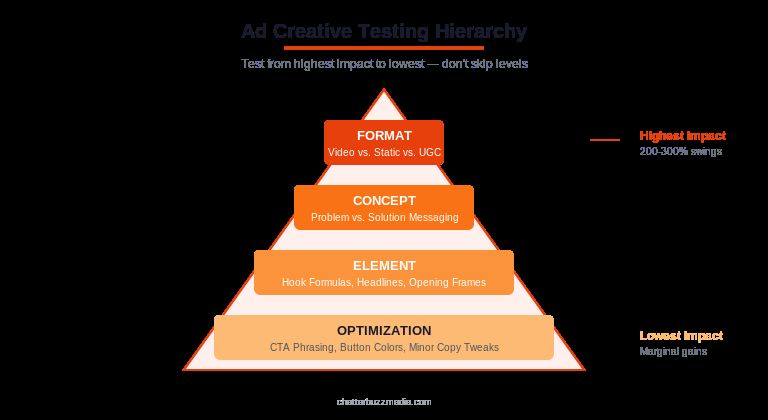
Not all creative elements are equally important. Test in this priority order:
Tier 1: Hook (First 3 Seconds)
This determines whether users scroll or watch. Test 5-10 different opening hooks:
– Problem callout (“Tired of [pain point]?”)
– Benefit statement (“Get [result] in [timeframe]”)
– Pattern interrupt (unexpected visual or statement)
– Question (“What if you could [desire]?”)
– Social proof (“10,000 customers choose…”)
Tier 2: Offer/Angle
The core message or unique selling proposition:
– Price/discount focus
– Quality/premium positioning
– Speed/convenience benefit
– Transformation/results focus
– Social proof/popularity
Tier 3: Creative Format
How you deliver the message:
– Talking head/founder story
– Product demonstration
– Customer testimonial
– Unboxing/first impressions
– Before/after results
– Lifestyle/use case scenarios
Tier 4: Visual Style
– UGC/raw style
– Polished brand content
– Animation/graphics
– Stock footage hybrid
Automation Tools for Scale
Leverage these tools to efficiently repurpose content:
Video Editing & Adaptation:
– Opus Clip: AI-powered short-form video generation from long content
– Submagic: Auto-caption generation with platform-specific templates
– Descript: Text-based video editing for quick variations
Design & Formatting:
– Canva: Multi-format templates and batch export
– Adobe Express: Quick resizing and format adaptation
– Figma: Design system for maintaining brand consistency
Creative Management:
– Smartly.io: Automated creative production and platform distribution
– Motion: Dynamic creative optimization across platforms
– Pencil: AI-powered ad generation and performance prediction
The Creative Refresh Schedule
Ad creative fatigues at different rates per platform:
– TikTok: Refresh every 3-7 days (fastest fatigue)
– Instagram/Facebook Feed: Every 7-14 days
– Instagram/Facebook Stories: Every 5-10 days
– Google Search: Every 30-60 days (text ads)
– Google Display/YouTube: Every 14-30 days
– Pinterest: Every 30-45 days (slowest fatigue)
Plan to produce new master assets monthly, with weekly variations and refreshes for high-spend platforms.
Putting It All Together: Your 90-Day Multi-Platform Launch
Days 1-14: Foundation
– Set up tracking (pixels, conversions, analytics) across all platforms
– Launch Google Search campaigns with 60% of budget
– Produce first round of master creative assets
– Begin building retargeting audiences
Days 15-30: Social Expansion
– Launch Meta campaigns (30% budget)
– Add one additional platform based on audience demographics (20% budget)
– Analyze first performance data
– Create platform-specific creative variations
Days 31-60: Optimization & Scaling
– Redistribute budget based on performance
– Scale winning campaigns by 20-30%
– Launch second creative theme/angle
– Implement retargeting campaigns across all active platforms
– Begin A/B testing creative hooks
Days 61-90: Full Multi-Platform Maturity
– Activate all relevant platforms
– Establish creative testing calendar
– Implement automated rules and bid strategies
– Analyze cross-platform attribution
– Plan next quarter’s creative production
By day 90, you should have a data-driven understanding of how each platform contributes to your overall customer acquisition strategy, with systematic processes for creative production and budget optimization.
The Multi-Platform Mindset Shift
Success in multi-platform advertising requires moving beyond single-channel optimization. Instead of asking “What’s my Meta ROAS?” ask “How do my platforms work together to move customers through the journey?”
Google might show a 4X ROAS while Meta shows 2.5X, but Meta might be driving the awareness that makes your Google campaigns profitable. TikTok might show weak direct conversions but dramatically reduce your customer acquisition cost across all platforms.
The most sophisticated advertisers in 2026 understand that platforms complement each other. Your job isn’t to find the single best platform—it’s to orchestrate a symphony where each channel plays its optimal role in your customer acquisition orchestra.
Start with one platform, master it, then systematically expand. Use the frameworks in this guide to navigate the specifications, allocate budgets intelligently, and repurpose creative efficiently. The brands dominating in 2026 aren’t running ads on one platform—they’re strategically present across the entire digital landscape, meeting customers wherever they are in their journey.
Frequently Asked Questions
Q: What’s the minimum budget needed to run multi-platform ad campaigns effectively?
A: To run effective multi-platform campaigns, you need at least $3,000-5,000 per month total. This allows approximately $50-100/day on your primary platform (Google or Meta) and $25-50/day each on 1-2 secondary platforms. Below these minimums, platforms struggle to exit the learning phase and optimize properly. If you have less budget, focus on mastering 1-2 platforms rather than spreading too thin across many channels.
Q: Which platform should I start with for my e-commerce business?
A: Start with Google Search and Shopping ads if you have an established product with existing search demand. This captures high-intent bottom-funnel traffic. If you’re launching a new or innovative product with low search volume, begin with Meta (Facebook/Instagram) or TikTok to build awareness and demand. The platform choice depends more on where your customers are in their buying journey than the platform itself.
Q: How do I avoid creative fatigue across multiple platforms?
A: Combat creative fatigue by implementing a rotating refresh schedule: TikTok every 3-7 days, Meta every 7-14 days, and Google/Pinterest every 30-45 days. Produce master creative assets monthly, then create multiple variations by testing different hooks, angles, and formats. Keep a content calendar with at least 4-6 creative concepts in rotation, and monitor frequency metrics—when frequency exceeds 3-4 on Meta or view-through rates drop on YouTube, it’s time to refresh.
Q: How should I attribute conversions when customers interact with multiple platforms before purchasing?
A: Use a blended attribution approach: (1) Monitor each platform’s native attribution to understand its reported performance, (2) Use Google Analytics 4 to track assisted conversions and multi-touch paths, (3) Calculate blended ROAS by dividing total revenue by total ad spend across all platforms, and (4) Run quarterly incrementality tests by pausing specific platforms to measure true impact. Expect platform-reported ROAS to be 30-50% higher than actual blended ROAS due to attribution overlap.
Q: What’s the most efficient way to repurpose creative content for different platform specifications?
A: Create master assets first: shoot 4K video in both 16:9 and 9:16 formats, capture high-resolution product photos, and record customer testimonials. Then use the aspect ratio matrix to create versions for every format (16:9, 9:16, 1:1, 4:5, 2:3). Finally, apply platform-native adaptations—add trending audio for TikTok, captions for Meta, text overlays for Pinterest. Tools like Opus Clip, Canva, and Submagic automate much of this repurposing process, allowing one shoot to fuel 3-6 months of multi-platform content.