Is Seedance 2.0 Actually Threatening Hollywood Production?
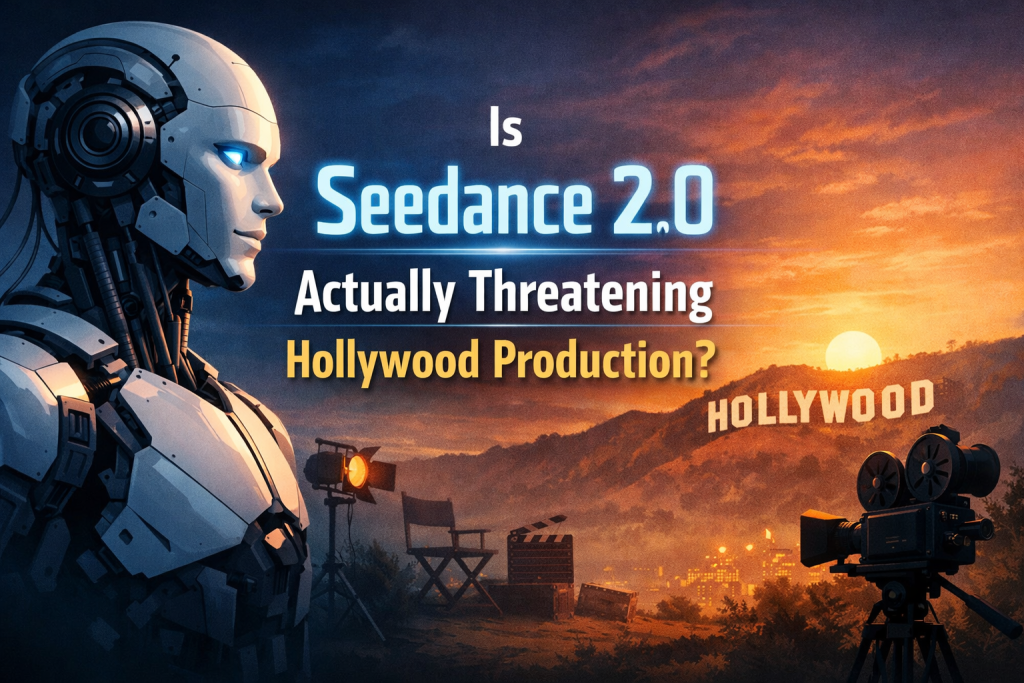
We spent way too long testing if Seedance 2.0 can actually replace Hollywood-level production.
The question isn’t academic. With AI video generation tools advancing at breakneck speed, the entertainment industry faces genuine uncertainty about whether these technologies represent an existential threat to traditional filmmaking or simply another tool in the creative arsenal. After weeks of hands-on testing with Seedance 2.0—generating everything from short narrative sequences to commercial-style content—we have data, not just hype.
The Disruption Question Everyone’s Asking
When OpenAI’s Sora demos dropped, followed by rapid iterations from Runway, Pika, and now Seedance 2.0, the entertainment industry’s response ranged from dismissive to apocalyptic. Union negotiations suddenly included AI clauses. Studio executives quietly explored budgetary implications. Independent creators wondered if their competitive advantage was evaporating.
But between the fear and the evangelism lies a practical question: Can AI video generation tools actually perform production tasks at a quality level that threatens professional workflows? Not in five years—right now.
The Real-World Test Results
Where Seedance 2.0 Genuinely Excels
After generating over 200 clips across multiple categories, several strengths became immediately apparent:
Speed for Concept Visualization: What would take a small production team days to storyboard and pre-visualize, Seedance 2.0 accomplishes in minutes. For directors pitching to studios or creators testing narrative concepts, this represents genuine value. We generated a noir-style chase sequence concept in under an hour that would have required location scouting, actors, and at minimum a skeleton crew.
Stock Footage Replacement: The most immediate commercial threat isn’t to Hollywood features—it’s to stock footage libraries. Need a slow-motion shot of coffee pouring? A sunset timelapse over generic cityscape? Seedance 2.0 delivers acceptable results at a fraction of traditional stock licensing costs. For YouTube creators, corporate video producers, and documentary filmmakers needing B-roll, the value proposition is undeniable.
Stylistic Experimentation: Testing aesthetic variations that would require complete re-shoots becomes trivial. We generated the same 10-second scene in film noir, cyberpunk, and Wes Anderson-inspired aesthetics in succession. For creative exploration, this iteration speed is genuinely transformative.
Budget-Constrained Creators: Independent creators without access to crews, equipment, or locations gain capabilities previously locked behind significant capital investment. A solo creator can now visualize complex sci-fi sequences that would be financially impossible through traditional means.
Where It Falls Catastrophically Short
But the limitations reveal why Hollywood isn’t panicking yet:
Character Consistency is Broken: The most glaring failure. We attempted to generate a simple three-scene character arc with the same protagonist. Despite identical prompts and character descriptions, facial features, clothing details, and even body types shifted between generations. For narrative work requiring character continuity—which is virtually all professional film and television—this is disqualifying.
Narrative Control Remains Primitive: You can suggest what happens, but you cannot direct it with the precision professional production demands. We requested a specific shot: character enters frame left, pauses at the window, turns to camera. Seedance 2.0 interpreted this loosely at best, completely ignored it at worst. Cinematographers and directors operate with shot-level precision; AI video generation still works in broad suggestion.
Performance Nuance Doesn’t Exist: Acting is microexpression, timing, and intentionality. AI-generated characters move and gesture, but there’s no performance—no deliberate emotional communication. Testing dramatic scenes revealed immediately that whatever Seedance 2.0 generates, it isn’t acting in any meaningful sense.
Physics and Spatial Consistency: Objects drift through space in ways that violate basic physics. Lighting changes mid-shot without source justification. Backgrounds warp subtly but noticeably. Professional audiences—and increasingly general audiences trained on high-quality content—perceive these artifacts immediately.
Duration Constraints: Most AI video tools, including Seedance 2.0, max out at 10-20 second generations. Stitching these together doesn’t create a coherent 2-minute scene, much less a feature film. Each generation is an island of content, not a building block for long-form narrative.
Act 2: What the Industry Actually Thinks
Professional Filmmakers: Cautious Curiosity
Conversations with working cinematographers, editors, and directors reveal a more nuanced position than public discourse suggests. Most view AI video tools as potentially useful for:
– Pre-visualization and pitching: Testing ideas before committing resources
– VFX planning: Roughing out complex sequences before handing to VFX teams
– Reference material: Generating visual references for production design
But not as replacement for principal photography. As one DP with 15 years experience put it: “It’s a sophisticated mood board generator, not a camera.”
The consensus: AI video tools might reshape pre-production workflows, but production itself remains largely unthreatened in the short-to-medium term.
YouTubers and Content Creators: Immediate Utility
For digital creators, the calculus differs dramatically. Many already rely on stock footage, basic B-roll, and visual filler content. AI generation tools offer:
– Lower costs than stock libraries
– Customization stock footage can’t provide
– Speed advantages over DIY shooting
Several mid-tier YouTubers (100K-500K subscribers) we surveyed are already integrating AI-generated B-roll into their workflow. Not for primary content, but for supplementary visuals. The quality threshold for supplementary YouTube content is dramatically lower than for theatrical release or premium streaming.
Studio Executives: Exploring Budget Implications
Studio interest focuses on cost reduction, not creative enhancement:
– Could AI tools reduce location shooting days?
– Can background elements be generated rather than built?
– What VFX tasks could migrate to AI generation?
But blockbuster tentpole productions—where studios make or lose hundreds of millions—aren’t candidates for experimentation. The risk tolerance isn’t there. Instead, expect testing on lower-budget productions, direct-to-streaming content, and specific VFX applications where failure doesn’t sink a project.
Labor and Union Concerns: Very Real
The WGA and SAG-AFTRA negotiations in 2023 included AI provisions for good reason. While AI video tools can’t yet replace actors or writers, the trajectory concerns labor organizations. Every advancement that reduces crew size, shooting days, or post-production staff represents potential job displacement.
The concern isn’t whether Seedance 2.0 specifically threatens livelihoods today—it’s whether the tool three or four generations from now does.
The Verdict—Threat or Tool?
Not a Threat to Hollywood Production (Yet)
After extensive testing and industry consultation, the evidence suggests Seedance 2.0 is not a genuine threat to professional Hollywood production workflows in their current form. The limitations—especially character consistency, narrative control, and performance—are too fundamental.
Hollywood productions operate on precision: specific shots, deliberate performances, intentional continuity. AI video generation operates on approximation: general concepts, suggested movements, statistical likelihood. These are incompatible paradigms for premium narrative content.
A Genuine Tool for Specific Applications
But dismissing AI video generation entirely misses its real impact:
Pre-Production Enhancement: Storyboarding, previsualization, and concept development will absolutely integrate these tools. The efficiency gains are too significant to ignore.
Independent Creator Empowerment: Solo creators and small teams gain capabilities previously requiring significant budgets. This democratization is real and valuable, even if the output doesn’t match Hollywood quality.
Commercial and Corporate Video: Industries with lower quality thresholds and higher volume demands (corporate training, social media advertising, internal communications) will adopt aggressively.
VFX Pipeline Integration: Not replacing VFX artists, but potentially serving as reference generators or first-pass visualizations that artists refine.
The Timeline for Real Disruption
If current advancement rates continue:
– 1-2 years: Stock footage industry faces significant disruption; YouTube B-roll generation becomes standard
– 3-5 years: Character consistency problems solved; low-budget narrative production begins integration
– 5-10 years: Potential integration into major production pipelines for specific applications
– 10+ years: Genuine threat to traditional production workflows (if advancement continues)
But this assumes linear progress, which is unlikely. Technical challenges like physics simulation, character consistency, and narrative control may prove harder than current hype suggests.
What Needs to Evolve
For AI video generation to genuinely threaten Hollywood production:
1. Character persistence across scenes and shots
2. Precise directorial control over camera movement, framing, and timing
3. Performance direction—actual acting, not random gestures
4. Extended duration generation (minutes, not seconds)
5. Physics and spatial consistency
6. Integration with traditional editing and color workflows
Seedance 2.0 hasn’t solved any of these. Until these problems are addressed, Hollywood production workflows remain largely insulated.
The Real Disruption Is Elsewhere
Perhaps the most important finding: the entertainment industry segment most threatened isn’t Hollywood—it’s the tier below it. Stock footage providers, low-budget commercial producers, corporate video teams, and supplementary content creators face immediate competitive pressure.
Meanwhile, Hollywood’s moat—talent, narrative craft, production precision, and performance—remains intact. For now.
AI video generation tools like Seedance 2.0 are powerful, legitimately useful, and rapidly improving. But they’re not replacing Hollywood production. They’re creating a new category of visual content generation that sits somewhere between stock footage and professional cinematography.
That’s significant. Just not in the way the hype suggests.
Frequently Asked Questions
Q: Can Seedance 2.0 actually replace traditional film production?
A: Not for professional narrative work. While Seedance 2.0 excels at concept visualization and B-roll generation, it fails at character consistency, narrative control, and performance nuance—all essential for traditional film production. It’s better understood as a pre-production and supplementary content tool rather than a replacement for cinematography.
Q: What is Seedance 2.0 actually good for?
A: Seedance 2.0 provides genuine value for concept visualization, storyboarding, stock footage replacement, YouTube B-roll generation, and stylistic experimentation. Independent creators and corporate video producers with lower quality thresholds and tighter budgets benefit most immediately.
Q: Are professional filmmakers worried about AI video tools?
A: Professional filmmakers express cautious curiosity rather than panic. Most see AI video tools as potentially useful for pre-production workflows but not as threats to principal photography. The bigger concern is long-term trajectory and potential job displacement in below-the-line roles over the next 5-10 years.
Q: What are the biggest limitations of AI video generation right now?
A: Character consistency is the most glaring problem—the same character looks different across generated clips. Other critical limitations include lack of precise directorial control, absence of genuine performance/acting, physics inconsistencies, and duration constraints (typically 10-20 seconds maximum).
Q: When will AI video tools actually threaten Hollywood production?
A: If current advancement rates continue, genuine integration into low-budget narrative production may occur in 3-5 years, with potential impact on major production pipelines in 5-10 years. However, this assumes solving fundamental problems like character persistence and performance direction, which may prove more difficult than current hype suggests.