Evolution of TV Advertising: 2026 Trends
TV advertising isn’t dead—it’s just different. Here’s what changed in 2026.
The television advertising landscape has undergone a remarkable transformation, defying predictions of its demise and instead evolving into something more sophisticated, integrated, and effective than ever before. As we examine the current state of TV advertising in 2026, three major trends have emerged that are reshaping how brands connect with audiences, how networks promote their content, and how the entire ecosystem of television and digital media intersects. For brand managers, media strategists, and advertising professionals, understanding these shifts isn’t just helpful—it’s essential for survival in an increasingly competitive attention economy.
Serial Promo Strategies: The New Storytelling in Advertising
The first major evolution in TV advertising centers on how networks are promoting new shows. Gone are the days of standalone 30-second spots that simply announce premiere dates and showcase quick cuts of action sequences. In 2026, serial promo strategies have transformed show promotion into an art form that rivals the programming itself.
Networks have adopted episodic promo campaigns that unfold across weeks or even months, creating narrative continuity that keeps viewers engaged between commercial breaks and across multiple viewing sessions. These aren’t traditional teaser campaigns—they’re sophisticated storytelling vehicles that introduce characters, establish world-building elements, and create genuine intrigue through carefully metered information releases.
Take the recent launch strategy for premium drama series. Rather than front-loading all promotional content in the week before premiere, networks are now releasing character-specific promo arcs that span six to eight weeks. Week one might introduce a protagonist through a 60-second character study. Week two reveals a key relationship. Week three hints at the central conflict. By the time the premiere arrives, audiences feel they already know these characters and are invested in their stories.
This approach addresses a fundamental challenge in modern television: the paradox of choice. With hundreds of new series launching annually across dozens of platforms, getting audiences to commit to trying a new show requires more than awareness—it requires emotional investment before the first episode even airs.
The data supports this strategy. Networks employing serial promo campaigns in early 2026 reported 34% higher premiere viewership compared to traditional promotional approaches, with significantly better retention through the first three episodes. More importantly, these campaigns generate organic social media conversation, with viewers theorizing about promo narratives and sharing speculation across platforms.
For brand managers, the lesson here extends beyond entertainment marketing. Serial advertising strategies are being adopted across categories. Automotive brands are launching multi-week campaigns that progressively reveal vehicle features. Consumer packaged goods companies are creating mini-narratives around product benefits. The key insight is that modern audiences, conditioned by binge-worthy content and complex storytelling, respond better to advertising that respects their intelligence and rewards their attention over time.
The production values of these serial promos have also elevated dramatically. Networks are investing in original footage shot specifically for promotional campaigns, often with the same directors and cinematographers working on the shows themselves. Some campaigns feature entirely separate narrative threads that complement but don’t duplicate the actual show content, giving super-fans additional story material to consume.
Integration: When Advertising Becomes Entertainment
The second transformative trend is the increasingly seamless integration of commercial content with entertainment programming. In 2026, the line between “show” and “ad” has become productively blurred in ways that benefit both advertisers and audiences.
This isn’t simply product placement—though that remains prevalent. The evolution centers on branded storytelling that delivers genuine entertainment value while serving commercial objectives. The most successful examples create content that viewers actively choose to watch, share, and discuss, even when they’re fully aware of the commercial intent.
Contextual ad insertion technology has matured significantly, enabling dynamic commercial experiences that adapt to narrative context, viewer demographics, and real-time data. When a cooking competition show breaks for commercial, viewers increasingly see ads for kitchen products, grocery delivery services, and culinary education—but these aren’t generic spots. They’re contextually customized creative that mirrors the tone, pacing, and even visual style of the program itself.
Advanced AI-driven creative platforms now enable what the industry calls “tonal matching,” where commercial creative automatically adjusts color grading, music tempo, and editing rhythm to align with the content immediately preceding and following the ad break. The result is a less jarring viewer experience and measurably higher ad recall.
Several major advertisers have gone further, partnering with content creators to develop “embedded storylines” where brand narratives become subplot elements within scripted programming. A financial services company might sponsor a character’s career advancement storyline. A technology brand might provide the products that drive plot developments. These integrations are clearly labeled and transparent, but they’re also organic to the story world.
The metrics are compelling: integrated brand storylines generate 2.7 times higher brand favorability scores than traditional spot advertising, and they’re completely DVR-proof—viewers can’t skip what’s woven into the narrative fabric.
For advertising students and emerging strategists, this integration trend represents a fundamental shift in required skill sets. Tomorrow’s TV advertisers need to think like screenwriters, understanding narrative structure, character development, and story arc. The most successful brand integrations in 2026 are those conceived by teams that include creative writers, cultural consultants, and entertainment industry veterans alongside traditional advertising professionals.
The ethical considerations are significant, of course. Industry standards have evolved to ensure clear disclosure and to prohibit integrations that might mislead viewers about editorial independence. The Federal Trade Commission updated guidelines in 2025 specifically addressing these practices, requiring on-screen disclosure language and preventing integrated advertising in news and documentary programming.
Cross-Platform Ecosystems: TV as the Hub
The third major trend—and perhaps the most impactful for media strategists—is the maturation of cross-platform promotion that positions television as the hub of multi-channel engagement ecosystems.
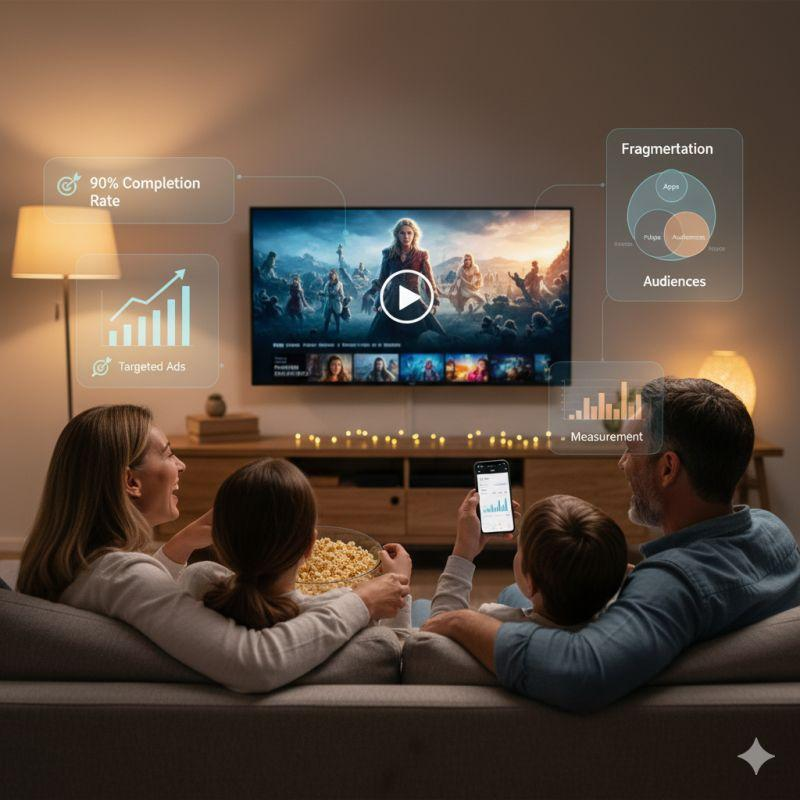
The 2026 approach recognizes that television reaches audiences at scale but that engagement, conversion, and measurement increasingly happen across digital touchpoints. Rather than treating TV and digital as separate channels, leading brands now architect unified campaigns where television spots serve as attention anchors that direct viewers into extended digital experiences.
Every TV commercial in 2026 is essentially an invitation to a deeper brand interaction. QR codes have become ubiquitous, but they’re now dynamic and context-aware, directing viewers to different landing experiences based on time of day, program content, and even local factors. A commercial airing during a weekend morning show might direct to family-friendly interactive content, while the same base creative during late-night programming opens an entirely different digital experience.
Second-screen synchronization has evolved from gimmick to standard practice. Brands and networks alike use audio watermarking and automatic content recognition (ACR) technology to trigger complementary mobile experiences precisely synchronized with TV content. When a commercial airs, viewer smartphones can automatically receive related content, limited-time offers, or interactive elements—all without requiring manual input.
The measurement revolution deserves special attention. For decades, TV advertising lived with delayed, sample-based measurement that provided limited insight into actual effectiveness. In 2026, cross-platform attribution has finally matured to provide reasonably accurate closed-loop measurement from TV exposure to digital action to offline purchase.
Advanced data clean rooms allow advertisers to match TV viewing data (via smart TV ACR technology and set-top box data) with digital behavior and purchase information while maintaining privacy compliance. Brands can now answer the question that haunted TV advertisers for generations: did this commercial actually drive sales?
The answer, consistently, is yes—but with important nuances. TV advertising in 2026 works best as part of a orchestrated sequence rather than as standalone exposure. The typical conversion path involves TV ad exposure creating awareness, followed by digital search or social media interaction, followed by retargeting display advertising, culminating in conversion. TV’s role is primarily upper-funnel, but its impact cascades through the entire customer journey.
Smart advertisers are optimizing for this reality. Rather than judging TV creative solely on direct response metrics, they’re evaluating how effectively spots drive the next-step behaviors: branded search volume, website visitation, social media engagement, and app downloads. Creative is specifically designed to be “digitally provocative,” including strategic questions, challenges, or curiosity gaps that almost demand a viewer to pull out their phone and learn more.
The production implications are substantial. TV commercials are no longer standalone units—they’re the first chapter in extended narratives that continue across YouTube, Instagram, TikTok, brand websites, and even physical retail environments. Creative teams must now think in terms of campaign ecosystems rather than individual spots.
The Future Is Integrated

As we assess the state of TV advertising in 2026, the overarching theme is integration—of promotional strategies that build over time, of commercial and entertainment content, and of television with the broader digital ecosystem.
For brand managers navigating this landscape, several strategic imperatives emerge:
Invest in narrative. Whether promoting a show or selling a product, serialized storytelling that respects audience intelligence delivers superior results compared to repetitive messaging.
Embrace transparency. Audiences accept and even appreciate commercial content when it’s clearly labeled and genuinely valuable. The integrations that work are those that enhance rather than interrupt the viewing experience.
Think ecosystems, not channels. TV remains uniquely powerful for reach and attention, but its full value manifests in how it activates behavior across other touchpoints. Design for the journey, not the moment.
Measure what matters. Direct response metrics tell only part of the story. Upper-funnel impact—awareness, consideration, brand perception—remains crucial and is now measurable with unprecedented precision.
Respect the medium. Television remains distinct from digital video. The lean-back experience, the larger screen, the often-communal viewing context, and the perceived premium quality of TV environments all matter. Strategies that simply repurpose digital creative for TV consistently underperform.
The reports of television advertising’s death were greatly exaggerated. What we’re witnessing instead is evolution—a medium adapting to new technologies, new audience behaviors, and new possibilities for creativity and measurement. The TV advertising of 2026 is more accountable, more integrated, more creative, and more effective than ever before.
For those willing to embrace its complexity and invest in its possibilities, television advertising remains one of the most powerful tools in the modern marketing arsenal. It’s just different—and that difference makes all the difference.
Frequently Asked Questions
Q: What are serial promo strategies in TV advertising?
A: Serial promo strategies involve creating episodic promotional campaigns that unfold over weeks or months, building narrative continuity rather than relying on standalone commercials. Networks release character-specific content progressively, creating emotional investment before a show even premieres. This approach has shown 34% higher premiere viewership compared to traditional promotion methods.
Q: How has commercial content integration changed in 2026?
A: Commercial content now integrates seamlessly with entertainment through branded storytelling, contextual ad insertion, and tonal matching technology. Ads adapt their style to match the surrounding program content, and some brands partner with creators to develop embedded storylines that become organic plot elements. These integrations generate 2.7 times higher brand favorability than traditional spots.
Q: What is cross-platform TV advertising?
A: Cross-platform TV advertising positions television as the hub of multi-channel engagement ecosystems. TV commercials serve as attention anchors that direct viewers to digital experiences through QR codes, second-screen synchronization, and audio watermarking. Advanced attribution now tracks the complete journey from TV exposure to digital action to purchase, providing closed-loop measurement.
Q: Is TV advertising still effective in 2026?
A: Yes, TV advertising is more effective than ever when properly integrated into broader marketing ecosystems. It excels at upper-funnel objectives like awareness and consideration, and when combined with digital follow-through, drives measurable business outcomes. The key is designing campaigns as ecosystems rather than standalone spots and measuring impact across the entire customer journey.
Q: What skills do TV advertising professionals need in 2026?
A: Modern TV advertising professionals need to think like screenwriters, understanding narrative structure and story arcs. They must design for cross-platform experiences, understand data attribution, and create content that works as part of extended ecosystems. Teams now include creative writers, entertainment industry veterans, and data analysts alongside traditional advertising roles.