Why Traditional SEO Is Dead and GEO Is the Future
Your SEO playbook from the last 20 years just became obsolete overnight.
If you’ve noticed your organic traffic declining despite maintaining your search rankings, you’re not imagining things. The fundamental architecture of how people find information online has shifted beneath our feet. The blue links you’ve spent years optimizing for are increasingly invisible to users who now get their answers without ever leaving the search page.
This isn’t a temporary algorithm update you can wait out. This is a paradigm shift that requires a completely new approach to digital visibility.
Act 1: The Answer Engine Revolution
The Death of the Click
For two decades, the SEO game was straightforward: rank higher, get more clicks, win more traffic. Google’s mission was to send users to the best websites as quickly as possible. That mission has fundamentally changed.
In May 2024, Google rolled out AI Overviews (formerly known as Search Generative Experience) to all U.S. users. These AI-generated summaries now appear at the top of search results for billions of queries, synthesizing information from multiple sources into comprehensive answers. Users get what they need without clicking a single link.
Meanwhile, ChatGPT has evolved from a chatbot into a search engine with real-time web access. Perplexity AI has built its entire platform around providing cited answers rather than link lists. Microsoft’s Copilot has integrated AI answers directly into Bing and Windows. Claude, Gemini, and a dozen other AI platforms are competing to become the default answer engine for different use cases.
The numbers tell the story: A study by Gartner predicts that traditional search engine volume will drop 25% by 2026, with AI chatbots and other virtual agents absorbing the difference. Zero-click searches—where users get their answer without visiting any website—already account for nearly 60% of Google searches.
What Answer Engines Actually Do
Unlike traditional search engines that match keywords to documents, answer engines synthesize responses from multiple sources. When you ask ChatGPT or Perplexity a question, it doesn’t just find the page with the best keyword optimization. It reads dozens of sources, extracts relevant facts, reconciles conflicting information, and generates a coherent narrative answer.
This process fundamentally changes what matters for visibility. Traditional SEO optimized for algorithms that looked at title tags, meta descriptions, backlink profiles, and keyword density. Answer engines look for something entirely different: authoritative, quotable, structured information that can be confidently cited.
Your perfectly optimized title tag means nothing if your content doesn’t provide the specific, credible facts the AI needs to construct its answer. Your backlink profile matters less than whether your content includes the depth and nuance that makes it citation-worthy.
The User Behavior Shift
Beyond the technology, user behavior has fundamentally changed. People increasingly expect immediate answers, not a list of websites to explore. They’re asking conversational questions, following up with clarifications, and expecting AI to do the synthesis work for them.
The traditional search pattern—type query, scan results, click three or four links, compare information, form conclusion—is being replaced by a conversational pattern: ask question, read AI summary, ask follow-up, get refined answer. The entire middle section, where your website used to capture attention, has been eliminated.
For digital marketers and business owners, this creates an existential crisis. If users never visit your website, how do you capture leads? How do you build brand awareness? How do you drive conversions? The old playbook of “rank and capture” no longer functions.
Act 2: Why Blue Links Don’t Guarantee Visibility Anymore
The Attention Trap Above the Fold
Let’s say you’ve maintained your #1 ranking for a valuable keyword. Congratulations—you’re now in second place. The AI Overview takes up the entire first screen, providing a comprehensive answer with citations to three or four sources. Users read the AI summary, get satisfied, and never scroll down to see your perfectly optimized listing.
Research from SparkToro found that after AI Overviews rolled out, organic click-through rates for top-ranking pages dropped by 18-64% depending on the query type. Information queries suffered the most—exactly the queries that drive top-of-funnel awareness and education.
Even when your site is cited in the AI Overview, it doesn’t guarantee traffic. The citation appears as a small superscript number or a compact source link. Users can get your information without ever visiting your site. You’ve become content infrastructure—valuable to the AI, invisible to the user.
The Zero-Click Economy
Traditional SEO operated on a value exchange: Google sent you traffic in return for providing quality content that satisfied user intent. That exchange has broken down. Now you provide the content, the AI consumes and repackages it, and the user gets satisfied without you receiving any direct benefit.
This affects different query types differently:
Informational queries (“how to,” “what is,” “why does”) are almost entirely captured by AI summaries. Users rarely need to visit the source.
Commercial queries (“best,” “review,” “vs”) are partially captured, with AI providing summaries but users sometimes clicking through for details.
Transactional queries (“buy,” “near me,” specific product names) still generate clicks, but AI is increasingly able to handle these through direct integrations with e-commerce platforms.
If your content strategy focused on informational content to build top-of-funnel awareness, you’re experiencing the steepest traffic declines. The content still ranks, but it’s being consumed through AI intermediaries rather than direct visits.
The Citation Without Attribution Problem
Here’s the cruelest irony: Your content might be powering dozens of AI responses without you realizing it. AI answer engines crawl your site, extract your insights, and synthesize them into responses—but the end user never sees your brand name, never visits your site, never enters your funnel.
Unlike traditional search where a #1 ranking meant prominent brand visibility, citation in an AI answer often means anonymous contribution. The user thinks “the AI told me this,” not “Company X provided this insight.” You’ve lost both the traffic and the brand attribution that traditional SEO provided.
The Ranking-Traffic Disconnect
For years, SEO tools tracked rankings as a proxy for traffic because the correlation was strong. That correlation has broken. You can maintain perfect rankings while watching traffic evaporate. Your rank tracking dashboard shows green arrows while your analytics shows red.
This creates confusion and misaligned strategies. Teams continue optimizing for rankings because that’s what they know how to measure, even as those rankings deliver diminishing returns. The metrics we’ve relied on for two decades no longer tell us what matters.
Act 3: How Generative Engine Optimization Changes Everything
From Keywords to Citations
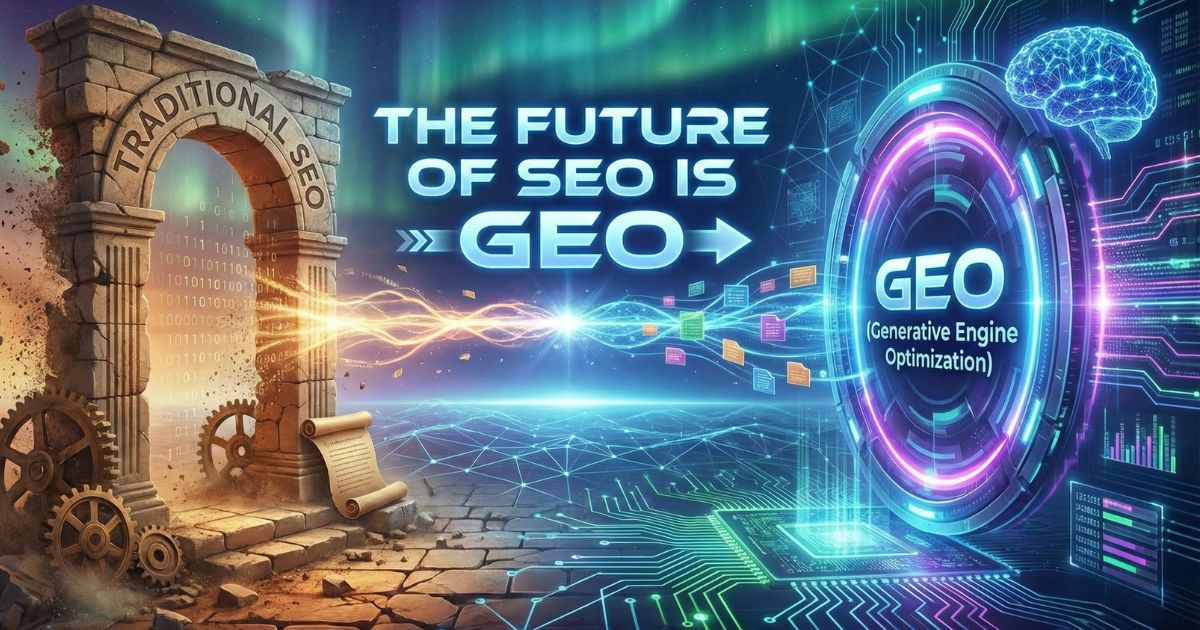
Generative Engine Optimization (GEO) represents a fundamental shift in how we think about digital visibility. Instead of optimizing to appear in a list of links, you’re optimizing to be cited as a source in AI-generated answers.
This changes what matters:
Traditional SEO prioritized:
– Keyword placement and density
– Title tag optimization
– Meta descriptions that drive clicks
– Backlink quantity and domain authority
– Content length for keyword coverage
GEO prioritizes:
– Factual accuracy and verifiability
– Structured, quotable statements
– Source credibility signals
– Unique data and original research
– Clear, authoritative explanations
The optimization target has shifted from search algorithms to AI comprehension and citation logic. You’re no longer trying to match keyword patterns; you’re trying to provide the specific, credible information that AI models feel confident citing.
The Nine Principles of GEO
1. Authoritative Sourcing
AI models prioritize sources they perceive as authoritative. This means E-E-A-T (Experience, Expertise, Authoritativeness, Trustworthiness) matters more than ever, but in a different way. Instead of satisfying human raters, you’re satisfying AI confidence thresholds. Include author credentials, cite primary sources, link to authoritative research, and demonstrate domain expertise.
2. Quotable Factoids
AI loves specific, standalone facts that can be extracted and cited. Instead of burying insights in rambling paragraphs, structure content with clear, quotable statements. Use formats like “According to [research], [specific stat].” Make your key points extractable.
3. Statistical Credibility
Original data and proprietary research are citation gold. AI models heavily favor content with specific statistics, especially when those stats can’t be found elsewhere. If you’re citing others’ research, link directly to primary sources to boost credibility signals.
4. Structured Clarity
AI models parse structured content more effectively. Use clear headings, bulleted lists, numbered steps, and tables. Break complex topics into discrete, well-labeled sections. Make your content machine-readable, not just human-readable.
5. Comprehensiveness Without Fluff
Cover topics thoroughly, but eliminate the keyword-stuffing filler that old SEO encouraged. AI models can detect comprehensive coverage versus repetitive keyword insertion. Answer related questions, address common follow-ups, and cover subtopics—but do it with genuine informational value.
6. Answer Directness
Traditional SEO often buried answers to capture more time on page. GEO requires the opposite: answer questions directly and clearly at the top of content sections. AI models extract the first clear answer they find, so front-load your key points.
7. Comparative Context
AI models love comparative content that helps them build nuanced answers. When explaining a concept, compare it to alternatives. When recommending something, explain why it’s better than options. Provide the context that helps AI generate balanced, comprehensive responses.
8. Recency Signals
Many AI systems prioritize recent information. Regular content updates, publication dates, and “as of [date]” statements help AI models understand information currency. Don’t let valuable content become stale—refresh it regularly with updated data and examples.
9. Source Transparency
Make it easy for AI to verify your information. Link to sources, cite research, name specific studies, and provide attribution. AI models reward transparency and penalize unsupported claims. Your citation credibility depends on your own citation practices.
Measuring GEO Success
Traditional SEO metrics don’t capture GEO performance. You need new measurement frameworks:
Citation tracking: Monitor how often your content appears in AI-generated answers across different platforms. Tools are emerging to track this, but manual testing across ChatGPT, Perplexity, Claude, and Google AI Overviews is currently necessary.
Source prominence: When cited, how prominently does your brand appear? Are you named directly or anonymously referenced? Primary citation or supporting source?
Query coverage: For how many relevant queries does your content get cited? Expand your keyword tracking to conversational questions and monitor AI responses.
Direct traffic patterns: As traditional organic declines, quality GEO should maintain or grow direct traffic as your brand builds authority even through indirect citation.
Conversion path evolution: Track how users who do visit convert differently. GEO often captures users later in their research journey since AI handles initial exploration.
The Strategic Shift Required
Implementing GEO means rethinking your entire content strategy:
Content audit: Review existing content for citation-worthiness. Which pieces have quotable stats, authoritative sourcing, and clear structure? Prioritize updating these.
Investment in original research: Proprietary data becomes your most valuable asset. Surveys, studies, original analysis—these create citation moats that AI must reference.
Author authority building: Strengthen author credentials, expertise signals, and biographical authority markers. Personal brand and demonstrated expertise matter more than domain authority.
Format diversification: Don’t put all content in long-form articles. AI models pull from diverse formats: FAQ pages, glossaries, research reports, case studies, and databases all serve GEO differently.
Platform presence: Your website isn’t the only citation source. Build presence on platforms AI models trust: industry publications, research databases, authoritative directories, and established platforms.
The Uncomfortable Truth
GEO won’t restore your traffic to pre-AI levels. The fundamental economics have changed. Where you once captured 100% of user attention through a website visit, you might now influence 30% of user decisions through indirect citation while receiving 10% of the traffic.
The value proposition shifts from “capture attention and convert” to “establish authority and influence.” You’re playing a longer game where brand authority, thought leadership, and trusted expertise compound over time, creating opportunities beyond direct website traffic.
Some businesses will struggle with this shift. If your model depends on high-volume, low-conversion organic traffic captured through educational content, the economics may no longer work. You’ll need to explore alternative monetization: direct AI integrations, platform partnerships, premium offerings for users who do convert, or entirely new business models.
The Path Forward
Traditional SEO isn’t completely dead—transactional and commercial queries still drive traffic, and AI hasn’t entirely replaced link-based search. But treating SEO as your primary digital visibility strategy is increasingly risky.
The marketers and businesses that thrive will be those who adapt quickly:
Start experimenting now. Test your content across multiple AI platforms. See what gets cited, what doesn’t, and why.
Build for AI first, humans second. This is the reverse of old advice, but AI is now your primary audience. Structure content for machine comprehension, then add human polish.
Invest in authority signals. Original research, expert authors, transparent sourcing, and verifiable facts are your competitive advantages.
Diversify visibility strategies. Don’t depend on any single channel. Build presence across platforms, invest in direct audience relationships, and create multiple paths to visibility.
Think beyond traffic. If citations without clicks become the norm, what metrics actually matter? Brand awareness? Social proof? Authority signals that drive conversions through other channels?
The shift from SEO to GEO isn’t a minor tactical adjustment. It’s a fundamental restructuring of how information flows online and how businesses build digital visibility. The playbook has changed. The question is whether you’ll change with it or keep optimizing for a game that’s already over.
Frequently Asked Questions
Q: Is traditional SEO completely dead or can it still drive traffic?
A: Traditional SEO isn’t completely dead, but its effectiveness is rapidly declining for informational queries. Transactional searches (buying intent) and local searches still generate clicks, but informational content—which many businesses used for top-of-funnel awareness—now gets consumed through AI summaries without driving website visits. You shouldn’t abandon SEO entirely, but relying on it as your primary visibility strategy is increasingly risky.
Q: What exactly is Generative Engine Optimization (GEO)?
A: GEO is the practice of optimizing content to be cited and referenced by AI answer engines like ChatGPT, Perplexity, Google AI Overviews, and Claude. Unlike traditional SEO which focuses on ranking in search results to generate clicks, GEO focuses on making your content citation-worthy so AI models reference your information when generating answers. This requires emphasizing factual accuracy, structured data, quotable statistics, authoritative sourcing, and clear expertise signals.
Q: How do I measure success with GEO if traffic is declining?
A: GEO requires new metrics beyond traditional traffic and rankings. Focus on citation frequency (how often AI platforms reference your content), source prominence (whether you’re named or cited anonymously), query coverage (for how many relevant questions you get cited), and brand authority signals. You’ll also need to track how the quality of traffic changes—users who do visit after AI exposure may be further along in their decision journey and more likely to convert.
Q: Should I stop investing in traditional SEO and switch entirely to GEO?
A: Don’t abandon traditional SEO entirely, but start shifting resources toward GEO principles. Many GEO practices (authoritative content, clear structure, comprehensive coverage) also benefit traditional SEO. Start by auditing your best-performing content for citation-worthiness, invest in original research and data, strengthen author expertise signals, and test how your content performs across multiple AI platforms. Treat this as a transition period where you optimize for both, gradually shifting emphasis as you learn what works.
Q: What types of content are most valuable for GEO?
A: Original research and proprietary data are the most valuable for GEO because AI models must cite them—they can’t find that information elsewhere. Beyond that, content with specific statistics, clear expert authorship, quotable factoids, comparative analyses, and structured explanations performs well. FAQ pages, glossaries, research reports, and data-driven case studies are particularly effective formats. Avoid thin, keyword-stuffed content that traditional SEO sometimes encouraged—AI models easily identify and ignore low-quality content.