
AI Uncertainty: The Math Behind Trustworthy AI

What if AI could tell you when it’s wrong? One researcher spent 30 years making that possible.
When Carl Edward Rasmussen began his PhD in the early 1990s, neural networks were barely functional curiosities. But he wasn’t focused on making them more accurate—he was obsessed with making them honest. While other researchers chased percentage points of improved performance, Rasmussen pioneered methods for AI systems to quantify their own uncertainty. Three decades later, as large language models reshape technology, his work on probabilistic machine learning has become the mathematical foundation for making AI systems we can actually trust.
Understanding how AI measures and communicates its confidence levels isn’t just an academic exercise. It’s the difference between an AI that fails silently and dangerously, and one that knows enough to say “I don’t know.”
Act 1: The Mathematical Architecture of AI Doubt
At the heart of uncertainty quantification lies a deceptively simple question: when an AI makes a prediction, how confident should it be?
Traditional machine learning models output point estimates—single answers with no accompanying confidence intervals. A medical diagnosis system might predict “cancer” with the same formatting whether it’s 51% confident or 99% confident. This black-box certainty is mathematically convenient but practically dangerous.
The solution begins with Bayesian inference, a 250-year-old statistical framework that treats uncertainty as a first-class citizen. Instead of learning a single set of model parameters, Bayesian approaches maintain probability distributions over all possible parameters. This seemingly small shift has profound implications.
Consider Gaussian Processes (GPs), one of Rasmussen’s signature contributions. Unlike neural networks that learn fixed weights, GPs define distributions over functions themselves. When making predictions, a GP doesn’t just output a value—it outputs a mean and variance. The mean represents the best guess, while the variance quantifies epistemic uncertainty: the confidence based on available training data.
The mathematics is elegant. A GP is fully specified by a mean function and a covariance (kernel) function. The kernel encodes assumptions about how inputs relate to each other. Given training data, the posterior distribution updates using Bayes’ theorem. The resulting predictive distribution provides both point estimates and uncertainty bounds automatically.
This framework reveals something crucial: uncertainty comes in two flavors. Aleatoric uncertainty represents irreducible randomness in the data itself—the inherent noise in measurements. Epistemic uncertainty represents knowledge gaps that more data could resolve. A trustworthy AI system must distinguish between “this is fundamentally unpredictable” and “I haven’t seen enough examples like this.”
But Gaussian Processes have limitations. They scale poorly to large datasets, with computational complexity O(n³) in the number of training points. This computational barrier kept them relegated to small-scale applications for years, even as their theoretical elegance was widely recognized.
Enter neural network uncertainty quantification. Researchers developed multiple approaches to inject probabilistic reasoning into neural architectures:
Bayesian Neural Networks place probability distributions over network weights rather than learning point estimates. During training, variational inference approximates the posterior distribution over weights. At prediction time, sampling multiple weight configurations generates an ensemble of predictions, with their variance indicating uncertainty.
Monte Carlo Dropout, pioneered by Yarin Gal, offers a remarkably simple trick: keep dropout active during inference. By randomly dropping different neurons across multiple forward passes, you effectively sample from an approximate posterior. The computational cost is minimal—just run the network several times—while the uncertainty estimates prove surprisingly reliable.
Deep Ensembles take a more straightforward approach: train multiple networks with different random initializations and average their predictions. While not strictly Bayesian, ensembles capture model uncertainty effectively. Their prediction variance indicates disagreement among committee members, signaling regions where the models are uncertain.
Each approach involves mathematical tradeoffs. Bayesian Neural Networks are theoretically principled but computationally expensive and difficult to train. Monte Carlo Dropout is fast but provides only approximate uncertainty. Deep Ensembles are practical but require training multiple full models.
The mathematical foundations extend beyond individual techniques. Proper scoring rules like the log likelihood or Brier score evaluate probabilistic predictions by rewarding both accuracy and appropriate confidence. A model that’s always 99% confident will be heavily penalized when wrong, incentivizing calibrated uncertainty estimates.
Calibration curves formalize this idea: plot predicted probabilities against observed frequencies. A perfectly calibrated model’s curve hugs the diagonal—when it says 70% confident, it should be correct exactly 70% of the time. Real models often exhibit overconfidence or underconfidence, requiring post-hoc calibration methods like temperature scaling.
Act 2: Why Confidence Matters More Than Accuracy
The critical insight is this: in real-world deployment, knowing when your model doesn’t know matters more than marginal accuracy improvements.
Consider autonomous vehicles. A self-driving car might correctly classify stop signs 99.9% of the time. Impressive—until you realize that the 0.1% failures could be fatal. But what if, in those ambiguous cases, the system recognized its own uncertainty and requested human intervention? The same 99.9% accuracy becomes dramatically safer when paired with uncertainty awareness.
Medical diagnosis systems face similar stakes. An AI diagnosing rare diseases from imaging data will inevitably encounter edge cases unlike its training distribution. An overconfident wrong diagnosis could delay proper treatment. But a system that flags “this case is outside my expertise, confidence low” enables appropriate specialist referral.
The out-of-distribution (OOD) detection problem crystallizes this challenge. Training data never covers all possible inputs. Production systems encounter unexpected situations constantly. Without uncertainty quantification, models extrapolate confidently into regions where they have no business making predictions.
Properly calibrated uncertainty enables selective prediction: refuse to answer when confidence falls below a threshold. This converts an unreliable always-on system into a reliable sometimes-on system with known performance guarantees. You trade coverage for precision—a worthwhile exchange in high-stakes applications.
Active learning showcases another critical application. When training data is expensive to label, uncertainty-guided sampling identifies the most informative examples. Query points where the model is most uncertain—these provide maximum learning signal per annotation. This strategy can reduce labeling requirements by orders of magnitude compared to random sampling.
The fairness and bias implications are equally significant. Uncertainty quantification can reveal when models are less reliable for underrepresented groups. If a facial recognition system shows higher uncertainty for certain demographics, that’s a red flag indicating insufficient training data or inherent bias. Making this visible enables corrective action rather than silent discriminatory failures.
Beyond safety and ethics, uncertainty enables better human-AI collaboration. Users calibrate their trust based on communicated confidence. A model that’s honest about limitations builds appropriate reliance—users learn when to defer to it and when to second-guess it. Overconfident models train users to either trust blindly (dangerous) or distrust entirely (wasteful).
Financial applications demonstrate the economic value. A trading algorithm that knows when market conditions differ from its training regime can pause trading rather than losing money on poor predictions. Credit scoring models that flag uncertain cases for manual review can reduce both false positives (denied creditworthy applicants) and false negatives (approved defaults).
The scientific impact extends further. Machine learning increasingly powers scientific discovery in fields from drug discovery to materials science to climate modeling. Scientists need to know which predictions are reliable enough to guide expensive experiments. Uncertainty quantification transforms AI from a black-box oracle into a scientific instrument with known error bars.
Act 3: Uncertainty Research Meets the LLM Era
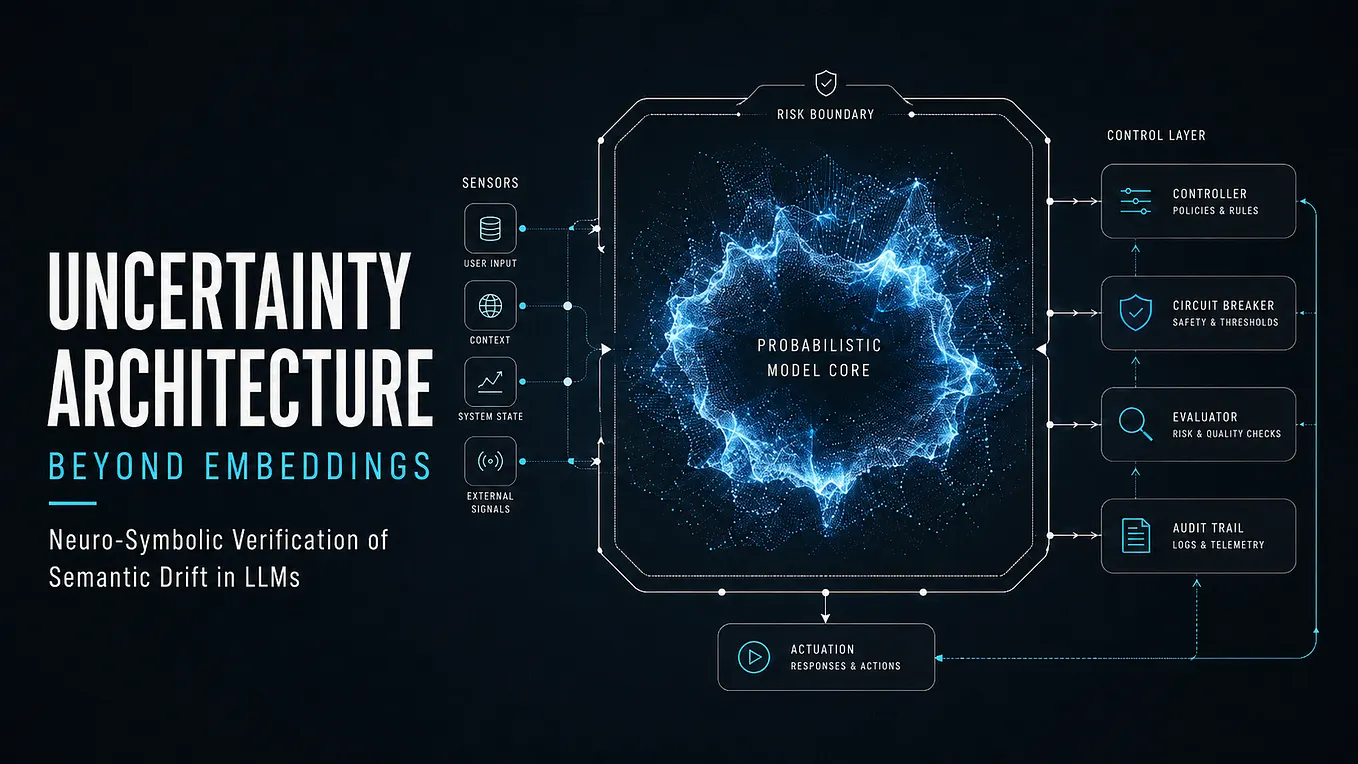
The explosion of large language models over the past five years has thrust uncertainty quantification from academic curiosity to existential necessity.
GPT-3, GPT-4, and their contemporaries exhibit a peculiar behavior: they hallucinate. When prompted for information they lack, they don’t admit ignorance—they confidently generate plausible-sounding fiction. This failure mode emerges directly from the training objective: predict the next token. These models aren’t trained to distinguish between “I know this” and “I’m making this up.”
The classic uncertainty quantification techniques translate imperfectly to LLMs. The scale alone poses challenges—175 billion parameters don’t fit neatly into Bayesian frameworks. Computing full posterior distributions becomes computationally infeasible. Monte Carlo Dropout shows promise but requires careful calibration. Deep Ensembles multiply already enormous computational costs.
Nevertheless, the research community has made significant progress adapting uncertainty methods to the LLM context:
Token-level confidence examines the softmax probabilities over the vocabulary. Low maximum probability indicates the model is uncertain about which token to generate next. Sequences with consistently low per-token confidence suggest the model is operating outside its comfort zone.
Verbalized uncertainty prompts models to express their own confidence in natural language. “I’m not certain, but…” or “To the best of my knowledge…” prefix generations that might be unreliable. While crude, this approach leverages the model’s own capabilities for self-assessment.
Consistency checking generates multiple responses to the same prompt with temperature sampling. High variance across samples indicates uncertainty. If the model gives different answers each time, it doesn’t have strong evidence for any particular response.
Semantic entropy measures uncertainty in the meaning space rather than token space. Different phrasings might convey the same meaning, while identical phrasings might be ambiguous. This approach clusters semantically equivalent generations and computes entropy over clusters, better capturing genuine uncertainty.
Retrieval-augmented generation architectures separate factual knowledge from language modeling. By grounding responses in retrieved documents, these systems can express uncertainty based on source reliability and relevance. If no relevant documents exist, the system can acknowledge knowledge gaps rather than hallucinating.
The challenges extend beyond technical implementation. Uncertainty quantification for text generation involves fundamental questions about what “confidence” even means. Is a model confident if it strongly predicts a specific token sequence, even if that sequence is factually incorrect? Should confidence be calibrated against human judgments of correctness? How do we handle subjective questions with multiple valid answers?
Alternative interpretations of LLM outputs reframe the uncertainty question. Perhaps we shouldn’t think of these models as knowledge bases that can be “uncertain” about facts. Instead, they’re statistical models of text distributions. Their “confidence” reflects how typical a given text continuation is, not whether it’s true. This perspective suggests we need fundamentally different notions of uncertainty for generative models versus discriminative ones.
The AI safety implications are profound. As LLMs become integrated into critical systems—from medical triage to legal research to educational tutoring—their inability to reliably communicate uncertainty poses genuine risks. A student relying on an AI tutor needs to know when it’s teaching established facts versus speculating. A lawyer using AI research tools must distinguish confident citations from hallucinated case law.
Recent research has shown that fine-tuning and reinforcement learning from human feedback (RLHF) can improve calibration. Models can learn to say “I don’t know” when appropriate, to cite sources, to express degrees of certainty. But these remain active research areas, with no consensus on best practices.
The commercial deployment considerations are equally complex. Users often prefer confident answers, even if wrong, to appropriately hedged uncertainty. Product designers face pressure to hide uncertainty behind clean interfaces. But this approach optimizes for short-term user satisfaction at the expense of long-term trust and safety.
Looking forward, the integration of uncertainty quantification into foundation models represents a critical research frontier. We need architectures that treat uncertainty as a core feature, not an afterthought. Training objectives should explicitly reward calibrated confidence. Evaluation metrics should assess not just accuracy but also uncertainty quality.
The three-decade journey from Gaussian Processes to GPT has vindicated the early uncertainty researchers. Their mathematical frameworks, once viewed as academic exercises, now provide the essential tools for making AI systems we can trust. As AI capabilities continue advancing, the ability to say “I don’t know” may prove more valuable than any amount of knowledge.
Conclusion
The question “what if AI could tell you when it’s wrong?” has an answer, built painstakingly over thirty years through mathematical rigor and empirical validation. Uncertainty quantification transforms AI from an overconfident oracle into a trustworthy tool that knows its own limits.
The techniques span from Bayesian inference to ensemble methods, from calibration curves to out-of-distribution detection. Each approach encodes the same fundamental insight: predictions without confidence intervals are dangerously incomplete information.
As large language models reshape the AI landscape, this work has never been more relevant. The systems dominating headlines need the mathematical foundations pioneered by researchers like Rasmussen. They need to distinguish between knowledge and hallucination, between confidence and certainty, between “I know” and “I’m guessing.”
The future of trustworthy AI depends not on eliminating uncertainty—that’s impossible—but on measuring, communicating, and acting on it appropriately. The math has been ready for thirty years. Now we need to use it.
Frequently Asked Questions
Q: What is the difference between aleatoric and epistemic uncertainty in AI systems?
A: Aleatoric uncertainty represents irreducible randomness inherent in the data itself—noise that exists regardless of how much data you collect. Epistemic uncertainty represents knowledge gaps that could be reduced by gathering more training data. For example, measurement noise in sensor data is aleatoric, while uncertainty about a rare edge case the model hasn’t encountered is epistemic. Understanding this distinction helps determine whether uncertainty can be reduced through more data or whether it’s fundamental to the problem.
Q: Why do large language models hallucinate instead of expressing uncertainty?
A: LLMs are trained with a next-token prediction objective that doesn’t explicitly distinguish between ‘known’ and ‘unknown’ information. The training process rewards generating plausible text continuations regardless of factual accuracy. The models aren’t inherently designed to evaluate their own knowledge or express confidence levels. This architectural limitation means they’ll confidently generate fabricated information that fits linguistic patterns, rather than indicating when they lack sufficient information to answer reliably.
Q: What are Gaussian Processes and why are they important for uncertainty quantification?
A: Gaussian Processes are probabilistic models that define distributions over functions rather than learning single function approximations. Unlike neural networks that output point predictions, GPs naturally provide both a mean prediction and a variance that quantifies uncertainty. This makes them theoretically ideal for uncertainty quantification. However, they have computational complexity O(n³) in the number of training points, limiting their scalability. Despite this limitation, GPs established the mathematical framework that influences modern uncertainty quantification approaches.
Q: How can uncertainty quantification improve AI safety in high-stakes applications?
A: Uncertainty quantification enables selective prediction—systems can refuse to answer when confidence is too low, requesting human intervention instead. In autonomous vehicles, this means flagging ambiguous situations for driver takeover. In medical diagnosis, it means referring uncertain cases to specialists. By making uncertainty explicit, systems avoid silent failures in critical situations. This approach trades coverage (answering fewer questions) for precision (being reliable when you do answer), which is essential for applications where mistakes have serious consequences.
Q: What is model calibration and why does it matter?
A: A calibrated model’s predicted probabilities match observed frequencies—when it says 70% confident, it should be correct exactly 70% of the time. Poor calibration means the model is systematically overconfident or underconfident, making its uncertainty estimates unreliable. Calibration matters because users need accurate confidence information to make decisions. An overconfident model trains users to trust it blindly, leading to failures. An underconfident model leads users to ignore it entirely. Proper calibration through techniques like temperature scaling ensures confidence levels provide actionable information.