Is AI Making Us Dumber? Latest Research Reveals Truth
Four years after ChatGPT launched, scientists have disturbing findings about what AI is doing to our brains.
The Cognitive Decline Data
The results are in, and they’re not encouraging. A 2024 study from the University of Pennsylvania tracked 800 knowledge workers over 18 months and found something startling: those who used AI writing assistants for more than 50% of their work showed a 17% decline in original idea generation when asked to work without AI assistance. Their ability to construct complex arguments independently had measurably deteriorated.
But it gets worse. Research from Stanford’s Digital Learning Lab published in early 2024 examined students who regularly used ChatGPT for assignments. When these students were later tested on material they’d previously submitted AI-assisted work about, their retention rates were 38% lower than students who’d completed the work manually. The AI users could barely remember the content they’d “written” just weeks earlier.
A separate neuroimaging study from MIT revealed actual changes in brain activity. Participants who used AI tools extensively for six months showed reduced activation in the prefrontal cortex—the brain region responsible for complex planning, decision-making, and critical thinking—when solving problems independently. The brain, it seems, was already learning to outsource.
These aren’t isolated findings. Across multiple institutions, researchers are documenting a pattern: intensive AI use correlates with measurable declines in the very skills the AI is meant to support.
The Mechanism: How AI Rewires Our Thinking
To understand what’s happening, we need to grasp a fundamental principle of neuroscience: neuroplasticity. Your brain physically changes based on what you do repeatedly. Practice piano, and you’ll develop more robust neural connections in regions controlling finger movement and auditory processing. Stop practicing, and those connections weaken.
The same applies to thinking skills.
When you struggle to find the right word, construct an argument, or synthesize information from multiple sources, you’re exercising specific cognitive muscles. These struggles aren’t inefficiency—they’re the workout that maintains and strengthens your mental capabilities.
AI short-circuits this process entirely.
Consider what happens when you use ChatGPT to write an email. Traditionally, composing even a simple professional email requires multiple cognitive operations: retrieving relevant information from memory, organizing thoughts logically, selecting appropriate tone and vocabulary, and editing for clarity. Each step exercises different neural networks.
With AI, you type a prompt and get a polished result. No struggle, no cognitive workout. You’ve outsourced the entire mental process.
Dr. Gloria Mark, a cognitive scientist at UC Irvine who studies human-computer interaction, explains it plainly: “We’re creating a cognitive dependency. The brain is incredibly efficient at eliminating neural pathways it doesn’t use. When AI consistently performs tasks that once required mental effort, those neural pathways weaken. It’s cognitive atrophy.”
The effect compounds across multiple domains:
Writing and Composition: Regular AI use for drafting means less practice in organizing thoughts, developing arguments, and refining expression. Users report increased difficulty writing independently, describing a feeling of being “lost” without AI assistance.
Research and Information Synthesis: When AI summarizes articles, extracts key points, and connects ideas across sources, users lose practice in critical evaluation, identifying patterns, and forming independent conclusions. The ability to distinguish quality sources from poor ones deteriorates.
Problem-Solving and Creativity: Perhaps most concerning, AI’s role in idea generation and brainstorming may be undermining our capacity for original thinking. A 2024 Copenhagen Business School study found that teams using AI brainstorming tools initially generated more ideas but, over time, showed decreased ability to produce novel solutions without AI assistance.
Memory Formation: The research on retention is particularly striking. When AI handles information processing, we engage in shallower cognitive processing. Deep learning requires effortful encoding—actively working with information, connecting it to existing knowledge, and retrieving it repeatedly. AI eliminates this effort, and memories fail to form properly.
Professor Sandra Waxman, a cognitive development researcher at Northwestern, offers a compelling analogy: “Imagine you started using a wheelchair despite having perfectly functional legs, simply because it’s easier. Within months, your legs would weaken significantly. That’s essentially what’s happening with cognitive abilities and AI tools.”
The Calculator Question: Are We Overreacting?
At this point, skeptics raise a valid objection: Didn’t people say the same thing about calculators? Weren’t we told that calculators would destroy our ability to do math? Yet society adapted fine, and we’re not mathematically impaired.
The calculator comparison is instructive—but perhaps not in the way AI optimists assume.
First, the concerns about calculators weren’t entirely wrong. Studies consistently show that people who grew up with constant calculator access have weaker mental arithmetic skills than previous generations. Most adults today struggle with calculations that their grandparents could do reflexively. We did lose something.
But we gained something arguably more valuable: the ability to tackle more complex mathematical problems. Freed from tedious calculation, students could focus on understanding mathematical concepts, recognizing patterns, and applying math to real-world problems. The calculator eliminated low-level drudgery, allowing humans to operate at higher cognitive levels.
The question is whether AI offers the same trade-off.
Dr. Neil Selwyn, an educational technology researcher at Monash University, argues there’s a crucial difference: “Calculators handle computation—a narrow, well-defined task. AI handles thinking itself. When we outsource arithmetic, we free up mental resources for higher-order math. When we outsource thinking, what exactly are we freeing ourselves up for? More thinking? But we’ve just outsourced that.”
The calculator reduced our need for one specific skill (mental arithmetic) while enhancing our capacity for broader skills (mathematical reasoning). AI threatens to reduce our capacity for the broad skills themselves—reasoning, synthesis, creativity, and critical thinking.
However, the calculator analogy offers genuine hope, because it demonstrates that technology’s impact depends entirely on how we use it.
Consider two students learning algebra. Student A uses a calculator for every arithmetic operation, never developing number sense or fluency with basic operations. Student B masters foundational arithmetic first, then uses a calculator strategically for complex problems where calculation would bog down the actual mathematical thinking.
Student B gets the best of both worlds—strong fundamentals plus technological enhancement. Student A becomes dependent on the tool and struggles when forced to work without it.
The same framework applies to AI.
Strategic AI Use: Enhancement vs. Replacement
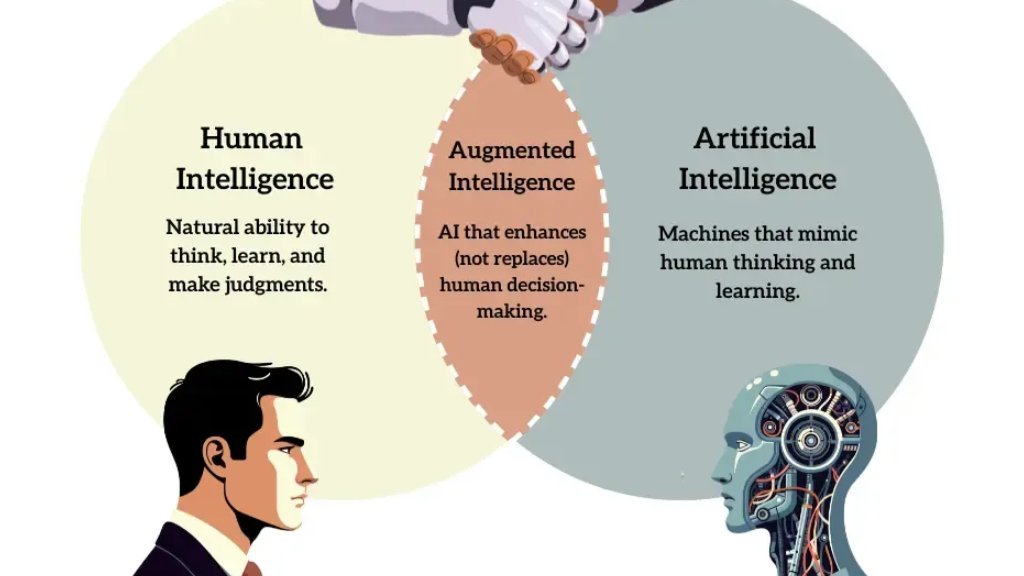
The research reveals a critical distinction: AI’s impact depends on whether it replaces cognitive effort or augments it.
A 2024 Harvard Business School study identified two distinct patterns of AI use among professionals:
Replacement users immediately turn to AI when facing any cognitive task. They use AI to write emails, generate ideas, research topics, and solve problems. They’ve essentially outsourced their thinking.
Augmentation users engage deeply with tasks first, using AI strategically to enhance their own thinking. They draft their own initial versions before asking AI for suggestions, research topics themselves before using AI to identify gaps, and generate their own ideas before using AI to explore alternatives.
The cognitive outcomes differed dramatically. After six months, replacement users showed measurable declines in the skills they’d outsourced. Augmentation users showed improvements—they were developing their own capabilities while leveraging AI to reach further.
The difference mirrors weight training with assistance equipment. Use assistance to lift heavier than you could alone, progressively building strength, and you get stronger. Use assistance to avoid effort entirely, and you atrophy.
Dr. Ethan Mollick, who studies AI’s workplace impact at Wharton, suggests concrete guidelines for cognitive-protective AI use:
1. Always engage first: Before consulting AI, spend at least 10-15 minutes working on the problem yourself. Draft your own initial version, generate your own ideas, attempt your own solution. This ensures cognitive engagement and maintains neural pathways.
2. Use AI for iteration, not creation: Let AI improve, expand, or challenge your work rather than create it from scratch. The initial creative and organizational thinking should be yours.
3. Regularly go AI-free: Designate certain tasks or time periods as AI-free zones. Like maintaining physical fitness requires actual exercise, maintaining cognitive fitness requires regular unassisted mental effort.
4. Treat AI output skeptically: Don’t accept AI suggestions passively. Evaluate them critically, compare them to your own thinking, and consciously decide what to incorporate. This active evaluation is itself valuable cognitive exercise.
5. Focus on understanding: If you use AI to explain something or solve a problem, ensure you genuinely understand the result. Can you explain it to someone else? Could you solve a similar problem independently? If not, you haven’t learned—you’ve just borrowed an answer.
The emerging consensus among cognitive scientists is clear: AI won’t make us dumber automatically, but it will if we let it think for us rather than with us.
The Path Forward: Conscious Choice
The research delivers an uncomfortable message: we’re at a crucial juncture. The choices we make now about how we integrate AI into our cognitive lives will shape our intellectual capabilities for years to come.
The optimistic take is that we have agency here. Unlike many technological changes that swept through society before we understood their impacts, we’re identifying AI’s cognitive effects in real-time. We can respond consciously and strategically.
Educational institutions are already adapting. Some universities now explicitly teach “AI hygiene”—guidelines for using AI tools in ways that support rather than replace learning. Companies are developing policies that encourage strategic rather than reflexive AI use.
The calculator ultimately made society more mathematically capable, not less—but only because we maintained focus on mathematical fundamentals while using calculators to tackle more complex problems. We can achieve the same with AI, but only if we’re intentional.
The question isn’t whether AI makes us dumber. The question is whether we’ll use it wisely enough to make ourselves smarter.
The disturbing findings from recent research aren’t a prediction—they’re a warning. They show us what happens when we outsource thinking entirely. But they also illuminate the path forward: maintain our cognitive fundamentals, use AI to augment rather than replace our thinking, and ensure that we’re always engaged in genuine mental effort.
Your brain is remarkably adaptable. Feed it challenges, and it grows stronger. Remove challenges, and it atrophies. AI can be either the ultimate cognitive challenge—forcing you to think at higher levels—or the ultimate cognitive crutch that lets your thinking muscles waste away.
The choice is entirely yours. But make no mistake: you are making a choice, whether consciously or not. Every time you turn to AI, you’re choosing which version of your cognitive future you’re building.
The research suggests you should choose carefully.
Frequently Asked Questions
Q: Does using AI tools like ChatGPT actually make you less intelligent?
A: Research shows that heavy AI use can lead to measurable declines in specific cognitive abilities—particularly in areas where AI replaces your thinking entirely. Studies have found 17% declines in original idea generation and 38% lower information retention among frequent AI users. However, this isn’t inevitable. Strategic AI use that augments rather than replaces your thinking can actually enhance cognitive abilities. The key is maintaining active mental engagement rather than passively accepting AI output.
Q: How is AI different from calculators in terms of cognitive impact?
A: Calculators handle narrow, well-defined computational tasks, freeing mental resources for higher-order mathematical thinking. AI, by contrast, can handle broad cognitive tasks like reasoning, writing, and creative thinking—the higher-order thinking itself. While calculators eliminated low-level drudgery so we could focus on concepts, AI risks eliminating the conceptual thinking too. However, like calculators, AI’s impact depends entirely on how we use it—strategically to enhance our capabilities or reflexively to replace them.
Q: What are the signs of unhealthy AI dependency?
A: Warning signs include: difficulty starting tasks without AI assistance, decreased confidence in your own ideas and writing, feeling ‘lost’ when required to work without AI, poor retention of information you’ve processed using AI, and immediately turning to AI for any cognitive task without attempting it yourself first. If you find yourself unable or unwilling to write an email, solve a problem, or generate ideas without AI assistance, you may have developed cognitive dependency.
Q: How can I use AI tools without damaging my cognitive abilities?
A: Follow the ‘augmentation, not replacement’ principle: Always engage with tasks yourself first before consulting AI (spend 10-15 minutes on initial work), use AI to improve or challenge your own thinking rather than create from scratch, regularly complete tasks entirely AI-free to maintain cognitive fitness, critically evaluate all AI output rather than accepting it passively, and ensure you genuinely understand anything AI helps you with. The key is maintaining active mental effort rather than outsourcing thinking entirely.
Q: Is this cognitive decline permanent or reversible?
A: The good news is that cognitive abilities are largely recoverable due to neuroplasticity—your brain’s ability to reorganize and strengthen neural pathways through use. Just as muscles can rebuild through exercise after atrophy, cognitive skills can recover through deliberate practice and mental effort. However, this requires conscious commitment to reducing AI dependency and regularly engaging in unassisted cognitive work. The longer you remain dependent, the more effort recovery requires, so early intervention is better.