Why Traditional SEO Is Dead and GEO Is the Future
Your SEO playbook from the last 20 years just became obsolete overnight.
If you’ve noticed your organic traffic plummeting despite maintaining your search rankings, you’re not imagining things. The fundamental architecture of how people find information online has shifted beneath our feet, and most marketers are still optimizing for a paradigm that no longer exists.
The culprit? AI answer engines have fundamentally transformed the search landscape. Google’s AI Overviews, ChatGPT’s SearchGPT, Perplexity AI, and similar platforms are answering user queries directly—without requiring users to click through to your meticulously optimized website. Your content might be ranking #1 in traditional search results, but if users are getting their answers from an AI-generated summary above those blue links, your traffic has essentially fallen off a cliff.
This isn’t a temporary disruption or a trend you can wait out. It’s a complete paradigm shift that demands an entirely new approach: Generative Engine Optimization (GEO).
Act 1: How AI Answer Engines Transformed Search
For two decades, the search engine optimization game had clear rules. You researched keywords, created content targeting those terms, built backlinks, optimized technical elements, and climbed the rankings. Position one on Google meant victory—traffic, leads, and revenue followed predictably.
That playbook is now broken.
The Rise of AI Overviews
Google’s AI Overviews (formerly SGE) now appear for approximately 84% of queries, according to recent data from BrightEdge. These AI-generated summaries sit prominently at the top of search results, synthesizing information from multiple sources into a comprehensive answer. Users get what they need without scrolling, much less clicking.
The impact is staggering. Early studies show that AI Overviews reduce clicks to traditional organic results by 18-64%, depending on query type. For informational queries—historically the bread and butter of content marketing—the decline approaches the higher end of that range.
ChatGPT Search and Perplexity’s Growing Influence
Meanwhile, ChatGPT’s integration of real-time search capabilities has transformed it from a knowledge cutoff-limited chatbot into a legitimate search alternative. With over 200 million weekly active users, ChatGPT now handles search queries that would have previously gone to Google.
Perplexity AI, while smaller, has carved out a dedicated user base by positioning itself explicitly as an “answer engine” rather than a search engine. It provides direct answers with source citations, training users to expect immediate, synthesized responses rather than a list of links to explore.
Claude, Gemini, and other AI assistants are following similar paths, each fragmenting the traditional search monopoly.
The Zero-Click Search Reality
We’ve entered the age of zero-click search at scale. SparkToro’s research indicates that nearly 60% of Google searches now end without a click to another property. Users are getting their answers directly from the search results page—whether through AI Overviews, featured snippets, knowledge panels, or other Google-hosted content.
For businesses, this creates an existential crisis. You can’t monetize traffic you don’t receive. You can’t capture leads from visitors who never visit. You can’t build brand relationships with users who consume your information through an AI intermediary that strips away your identity.
Act 2: Why Top Rankings No Longer Guarantee Visibility
The disconnect between rankings and results has created confusion and frustration among marketers who are “doing everything right” according to traditional SEO best practices.
The Attribution Problem
When an AI engine synthesizes information from twelve different sources to answer a query, which website gets the credit? The answer is often “none of them” in any meaningful way.
Google’s AI Overviews occasionally include source links, but they’re typically collapsed behind a “show sources” button that few users click. The information is presented as Google’s answer, not your answer. Your expertise, your brand, and your call-to-action are completely divorced from the content you created.
ChatGPT’s search implementation similarly provides synthesis first, citations second. Users get their answer and move on, rarely clicking through to source material unless they need deeper expertise or verification.
The Visibility Paradox
Here’s the cruel irony: your content might be extensively cited by AI engines—contributing significantly to their answers—while delivering virtually no traffic to your website.
You rank well in traditional results. AI engines clearly find your content valuable enough to reference. But users never reach your site because the AI has already extracted and repackaged your value proposition.
This creates what I call the “visibility paradox”—you’re influential but invisible, cited but uncredited, valuable but unrewarded.
The Commercial Intent Shift
Traditional SEO wisdom held that commercial and transactional keywords were most valuable because they indicated purchase intent. Informational content was the top-of-funnel awareness play.
AI answer engines have inverted this model. Commercial queries increasingly receive AI-generated comparisons, recommendations, and purchase guidance—complete with pricing, features, and pros/cons—without requiring users to visit individual vendor websites.
Meanwhile, highly specific or niche informational queries may still drive clicks because AI engines lack sufficient training data to answer confidently.
The keyword categories that matter have fundamentally shifted.
The Trust Transfer
Perhaps most concerning is the trust transfer occurring in user psychology. When Google or ChatGPT provides an answer, users increasingly trust the AI platform rather than questioning the underlying sources.
Your brand authority becomes anonymized. Your expertise is filtered through an AI intermediary. The trust relationship you’ve built through consistent, high-quality content is transferred to the platform that surfaces it.
This has profound implications for thought leadership, brand building, and long-term competitive positioning.
Act 3: What Generative Engine Optimization Does Differently
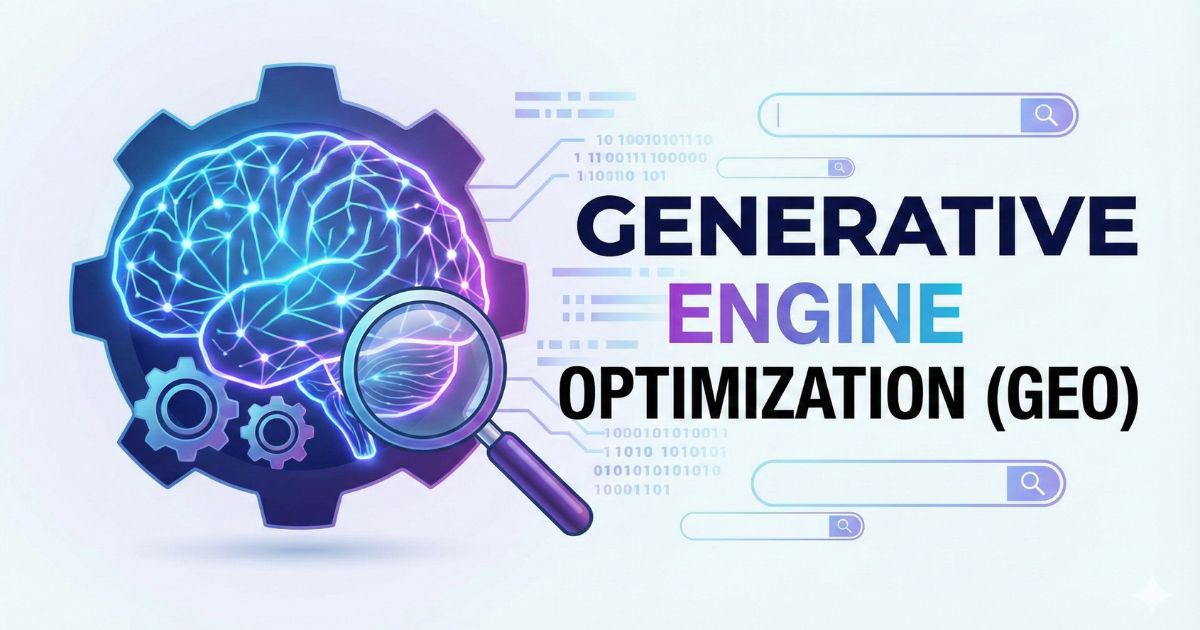
Generative Engine Optimization represents a fundamental rethinking of how to gain visibility in an AI-mediated information landscape.
From Keywords to Concepts
Traditional SEO focused on keyword targeting—identifying specific terms and phrases users search for, then optimizing content around those queries.
GEO shifts to concept comprehension. AI engines don’t match keywords; they understand semantic relationships, context, and conceptual frameworks. Your content needs to establish clear conceptual authority and demonstrate comprehensive understanding of topic relationships.
This means structuring content around concept clusters rather than keyword silos, explicitly connecting related ideas, and providing context that helps AI engines understand where your information fits within broader knowledge frameworks.
Citation-Worthy Content Architecture
AI engines preferentially cite certain content characteristics:
Statistical claims with clear sourcing: Original research, proprietary data, and well-documented statistics get cited more frequently because AI engines can reference them as authoritative sources.
Clear, definitive statements: Ambiguous or hedged language gets synthesized away. Direct, confident claims (when justified) are more likely to be extracted and cited.
Structured, scannable formats: Lists, tables, comparisons, and clearly delineated sections make it easier for AI to extract and attribute specific information points.
Quotable expertise: Named expert quotes and attributable perspectives provide AI engines with citation-worthy material that adds authority to their synthesized answers.
GEO content architecture deliberately optimizes for these citation patterns rather than traditional on-page SEO factors.
Entity Establishment and Association
AI engines understand the world through entity relationships. They know that “Apple” the company is distinct from “apple” the fruit, and they understand complex relationships between people, organizations, concepts, and topics.
GEO requires establishing your brand, key personnel, and core topics as recognized entities with clear relationship mappings. This involves:
– Consistent schema markup implementation
– Knowledge graph presence (Google, Wikidata, etc.)
– Entity-focused content that clearly establishes expertise in specific domains
– Cross-referencing and internal linking that reinforces entity relationships
Perspective and Unique Angle Optimization
When AI engines synthesize information from multiple sources, they often look for diverse perspectives to present balanced answers. Generic, commodity content that echoes what’s already widely available holds little value.
GEO prioritizes:
Unique methodologies: Proprietary frameworks or approaches that can’t be easily replicated from other sources.
Original research and data: Information that exists nowhere else, forcing AI engines to cite you if they want to include it.
Contrarian or underrepresented perspectives: Viewpoints that add diversity to AI-generated answers.
Practical implementation details: Step-by-step processes, specific examples, and granular how-to information that goes beyond surface-level overviews.
Platform-Specific Optimization
Different AI engines have different priorities, training data sources, and citation behaviors. GEO requires understanding these distinctions:
Google AI Overviews tend to favor content that already ranks well organically and comes from established, authoritative domains. Traditional domain authority still matters here.
ChatGPT appears to weight more recent content and diverse source types, including academic papers, forums, and social discussions alongside traditional web content.
Perplexity emphasizes source transparency and tends to cite content with clear structure and specific, verifiable claims.
Optimizing for all platforms simultaneously requires identifying common citation factors while understanding platform-specific nuances.
The New Metrics That Matter
GEO requires new measurement frameworks. Traditional metrics like keyword rankings and organic traffic tell an incomplete story.
Key GEO metrics include:
Citation frequency: How often your content is referenced by AI engines (requires monitoring tools specifically designed for this).
Source visibility: Whether your brand receives attribution when cited.
Concept association: Which topics and queries result in your content being synthesized into AI answers.
Answer inclusion rate: The percentage of AI-generated responses in your domain that incorporate your information.
Traffic quality over quantity: Since traffic volumes may decline, focus shifts to the quality and conversion rate of traffic that does arrive—users seeking deeper information beyond AI summaries.
Building Direct Relationships
Perhaps most importantly, GEO recognizes that you can’t solely depend on algorithmic visibility—whether traditional search or AI-mediated.
The strategy must include:
Email list building: Owned audience channels insulate you from algorithmic changes.
Community development: Direct platforms (forums, Discord, social groups) where you control the relationship.
Newsletter and subscription models: Regular, direct communication that doesn’t depend on search visibility.
Personal brand building: Individual thought leaders who build direct follower relationships across platforms.
These direct channels provide stable traffic sources even as AI engines continue fragmenting traditional search traffic.
The Transition Strategy
Adopting GEO doesn’t mean abandoning traditional SEO overnight. The transition requires a hybrid approach:
Audit current content for citation-worthiness: Identify which existing content has characteristics that AI engines value, then enhance it with additional statistical support, clearer structure, and unique perspectives.
Develop original research initiatives: Even modest proprietary research creates citation-worthy material that didn’t exist before.
Implement comprehensive entity optimization: Ensure your brand, products, and key personnel are properly represented as entities across knowledge graphs.
Create platform-specific content experiments: Test what gets cited on different AI platforms and refine your approach based on results.
Build measurement systems: Implement tools and processes to track citation frequency and AI visibility alongside traditional SEO metrics.
Invest in owned channels: Accelerate development of direct audience relationships that don’t depend on algorithmic visibility.
The marketers who make this transition early will build sustainable competitive advantages. Those who cling to traditional SEO playbooks will watch their organic traffic continue its inexorable decline, wondering why their rankings no longer deliver results.
Your SEO playbook from the last 20 years just became obsolete overnight. The question isn’t whether to adapt, but how quickly you can make the shift to Generative Engine Optimization before your competitors do.
Frequently Asked Questions
Q: What is the main difference between SEO and GEO?
A: Traditional SEO focuses on ranking highly in search engine results pages to drive clicks to your website. Generative Engine Optimization (GEO) focuses on getting your content cited and included in AI-generated answers, since users increasingly get information directly from AI engines like ChatGPT, Google AI Overviews, and Perplexity without clicking through to websites.
Q: Can I still use traditional SEO tactics alongside GEO?
A: Yes, a hybrid approach is recommended during the transition period. Traditional SEO fundamentals like domain authority still influence some AI engines, particularly Google AI Overviews. However, you should increasingly prioritize GEO tactics like creating citation-worthy content with original research, clear entity establishment, and unique perspectives that AI engines want to reference.
Q: How do I measure success with Generative Engine Optimization?
A: GEO requires new metrics beyond traditional keyword rankings and traffic volume. Focus on citation frequency (how often AI engines reference your content), source visibility (whether you receive attribution), concept association (which topics link to your brand), and traffic quality over quantity. Specialized monitoring tools are emerging to track these GEO-specific metrics.
Q: Why is my organic traffic dropping even though my rankings haven’t changed?
A: This is the visibility paradox—AI answer engines like Google AI Overviews now appear for approximately 84% of queries, providing synthesized answers at the top of search results. Users get their information without clicking through to websites, even those ranking #1. Studies show AI Overviews reduce clicks to organic results by 18-64%, with informational queries experiencing the steepest declines.
Q: What type of content do AI engines prefer to cite?
A: AI engines preferentially cite content with specific characteristics: statistical claims with clear sourcing, original research and proprietary data, clear and definitive statements, structured formats like lists and tables, named expert quotes, unique methodologies, and practical implementation details. Generic content that echoes existing information holds little citation value.